
Published by: Zhang Minxi | Date: September 1, 2026
Global warming is continuing to reshape the Earth’s hydrological cycle and extreme-precipitation processes, profoundly affecting the occurrence of natural hazards such as floods and landslides. Research on how landslides respond to climate change has traditionally focused on changes in event frequency, rainfall intensity, and triggering thresholds. Far less is known about whether the time of year in which landslides are concentrated—the seasonal timing of landslide activity—is also undergoing systematic change. This seasonal timing defines the annual activity window for landslide hazards and has major scientific and practical implications for disaster preparedness, infrastructure safety, and risk management.
The issue is particularly important in the Mediterranean, where wet and dry seasons are strongly differentiated. Landslides are controlled not only by the intensity of individual rainfall events, but also by antecedent hillslope wetness and the timing of rainfall: rainfall of the same intensity can have very different triggering effects on a wet slope than on a dry one. Climate change may therefore alter landslide behavior not only through changes in total rainfall or the frequency of extreme events, but also by reorganizing the temporal coupling between extreme precipitation and antecedent moisture accumulation, thereby reshaping the annual rhythm of landslide activity.
A team led by Professor Honghu Zhu of Nanjing University investigated the western–central Mediterranean and the Atlantic Iberian sector (Figure 1). The researchers integrated an inventory of rainfall-triggered landslides from 1991 to 2020 with ERA5 hydroclimatic data, and combined circular seasonal statistics, causal forests, PCMCI conditional-dependence analysis, and CMIP6 multi-model climate simulations to systematically assess regional changes in landslide timing and their relationships with extreme precipitation, antecedent wetness, and large-scale atmospheric circulation.
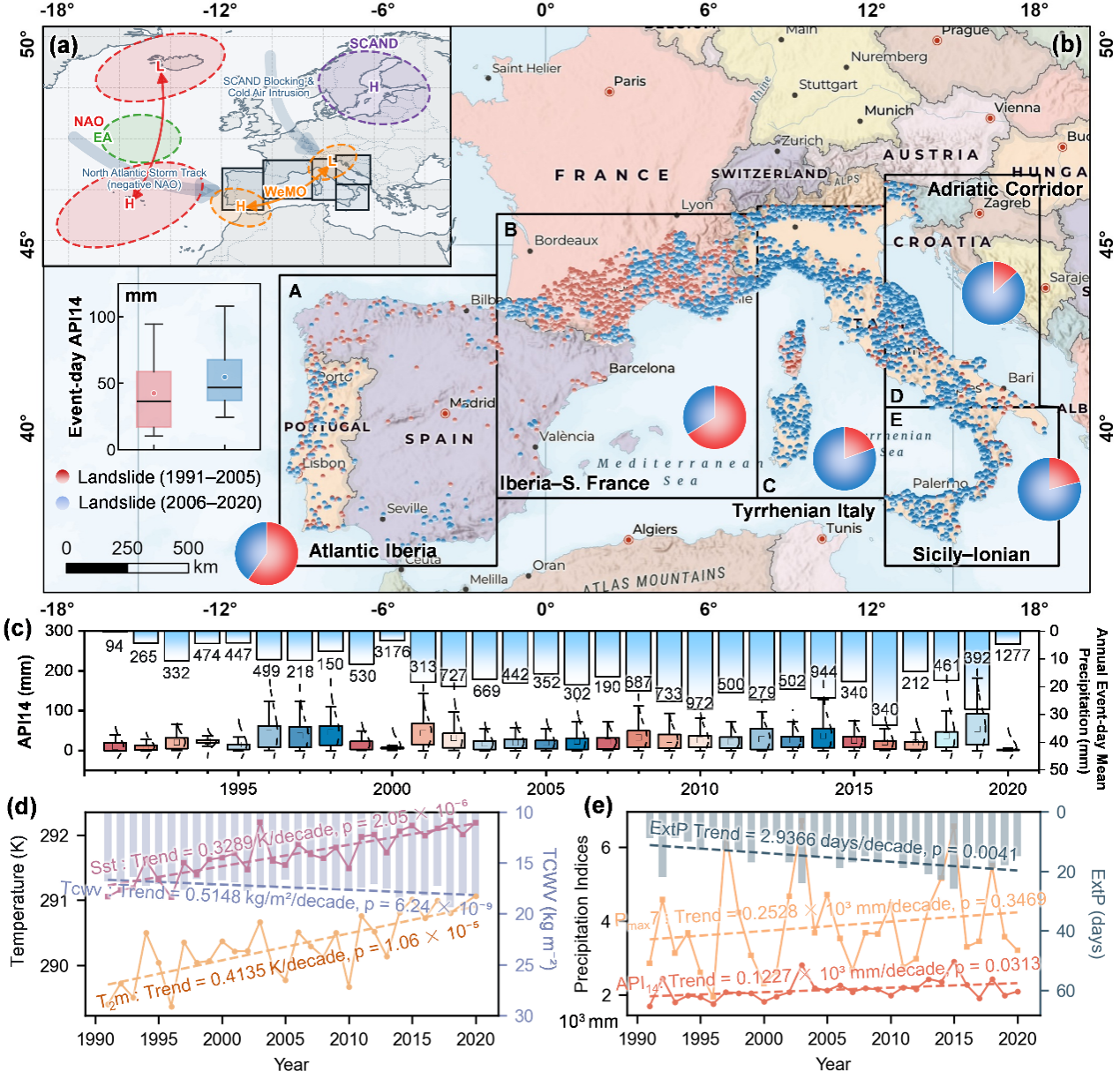
Figure 1. Study region in the western Mediterranean and the large-scale atmospheric circulation setting.
The study finds that landslide seasonality across the region has not shifted uniformly earlier or later over the past three decades. Instead, it has undergone a pronounced spatially heterogeneous reorganization. Across spatial scales, changes in seasonal timing are driven not only by regional hydroclimatic factors, but also by local topography and geomorphology, engineering-geological interfaces, and hillslope hydrological response. As shown in Figure 2, the onset of landslide activity has shifted earlier in Iberia–southern France and Atlantic Iberia, while it has shifted later in the Adriatic Corridor and Sicily–Ionian region. The duration of the activity window has also expanded or contracted to different degrees among regions. These patterns show that under global climate change, landslide response is expressed not only through changes in the number of events, but also through a redistribution of when activity occurs within the year.
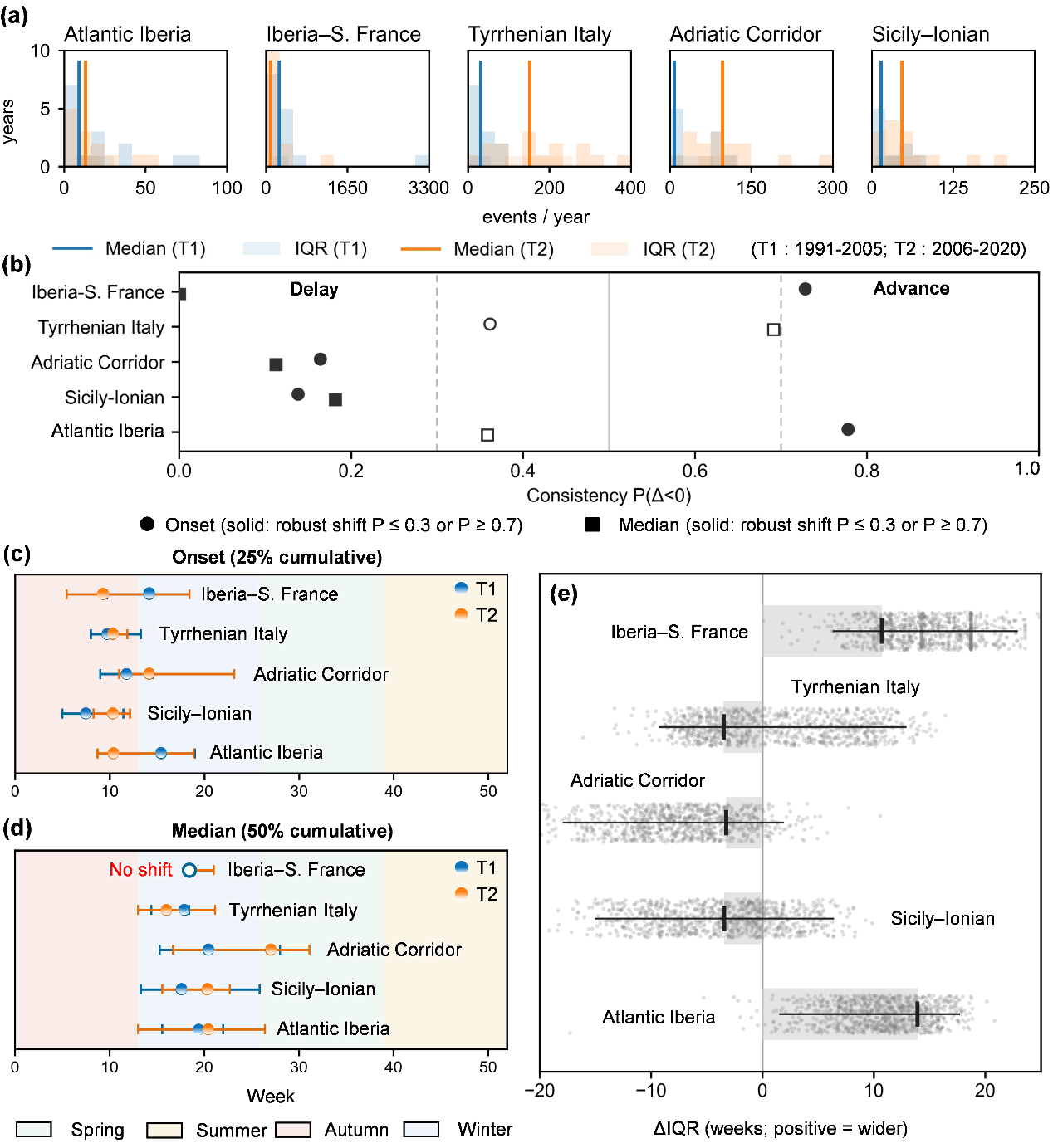
Figure 2. Comparison of seasonal landslide timing between 1991–2005 (T1) and 2006–2020 (T2).
Causal-effect analysis further reveals clear seasonal differences (Figure 3). In autumn, a one-standard-deviation increase in the frequency of extreme precipitation and in the 14-day antecedent precipitation index (API14) delays the median timing of landslides by approximately 9 days and 5 days, respectively. In summer, by contrast, higher API14 is associated with an advance of about 7 days in median landslide timing. Large-scale circulation modes—including the North Atlantic Oscillation (NAO), East Atlantic pattern (EA), Scandinavian pattern (SCAND), and Western Mediterranean Oscillation (WeMO)—primarily influence landslide seasonality indirectly by modulating storm tracks and moisture transport, rather than directly determining when landslides occur.
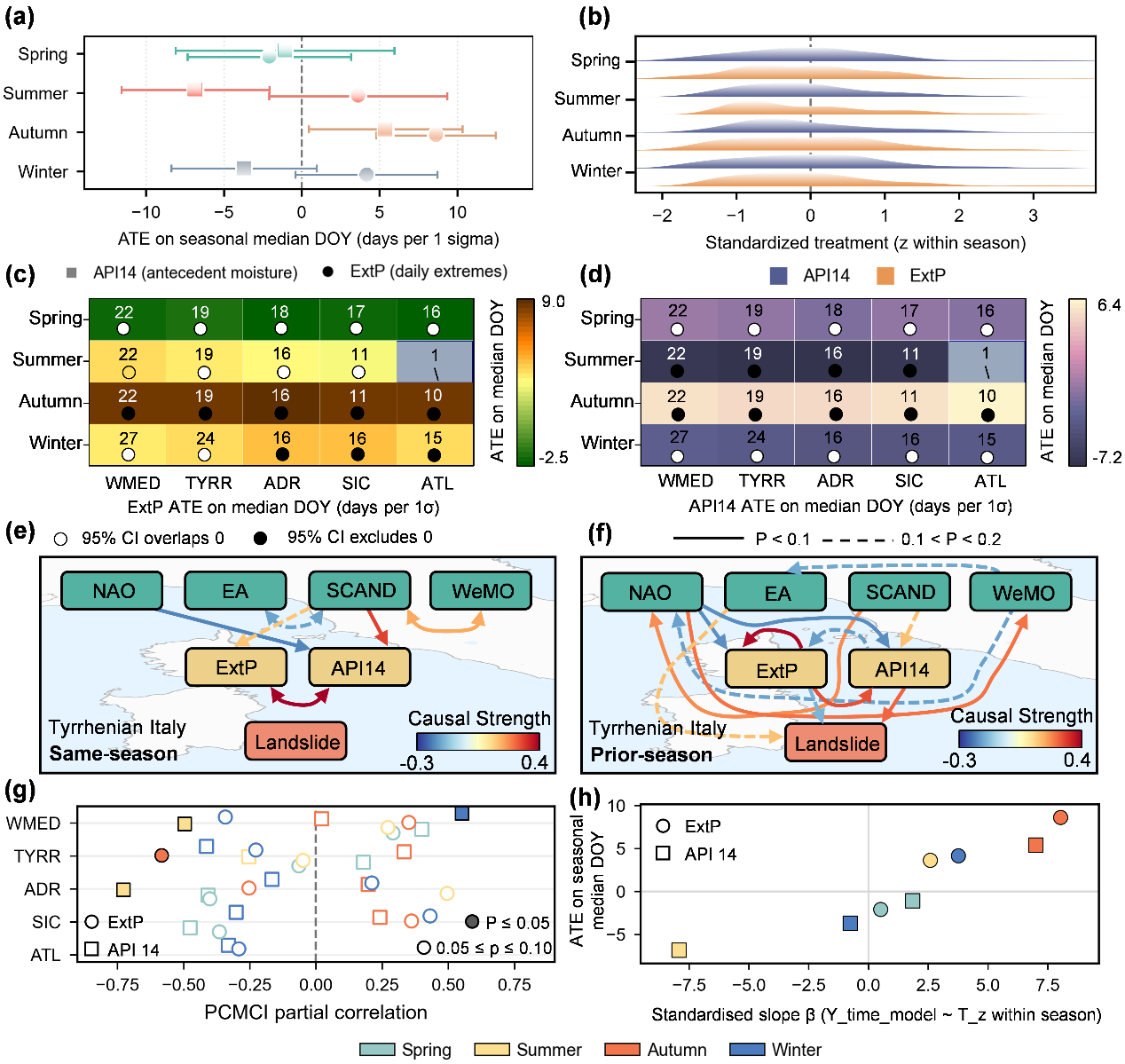
Figure 3. Causal effects (average treatment effects, ATEs) of hydroclimatic factors on seasonal landslide timing.
Analysis of the CMIP6 multi-model ensemble further indicates that, under the high-emissions SSP5-8.5 scenario, API14 is projected to decline by about 20% across most of the Mediterranean by the end of this century, whereas changes in the frequency of extreme precipitation are more strongly dependent on region and season. Future changes in landslide seasonality may therefore be expressed primarily through a reorganization of the relationship between extreme precipitation and antecedent wetness, rather than as a uniform shift in timing across the Mediterranean. By examining landslide hazards from the perspective of seasonal timing, the study expands understanding of how landslide activity may evolve under climate change and clarifies the multiscale links among large-scale atmospheric circulation, regional hydroclimate, and landslide seasonality. The results can provide a scientific basis for identifying seasonal landslide risk and optimizing disaster-prevention windows at the regional scale.
The study, entitled “Hydroclimatic controls link atmospheric circulation to seasonal landslide timing across the western Mediterranean,” was recently published in Communications Earth & Environment, a Nature Portfolio journal. Bofan Yu, a doctoral student in the School of Earth Sciences and Engineering at Nanjing University, is the first author, and Professor Honghu Zhu is the corresponding author. Co-authors include Dr Kushanav Bhuyan of Chengdu University of Technology; Associate Professors Wei Zhang and Daoyuan Tan of Nanjing University; Associate Professor Xiao Ye of Nanjing University of Information Science and Technology; and Professor Filippo Catani of the University of Padua, Italy.
The research was supported by the National Science Fund for Distinguished Young Scholars (42225702), an international cooperation project of the National Natural Science Foundation of China (42461160266), and the European Union’s Marie Skłodowska-Curie Actions UPGRADE project (101131146), among other sources.
1.Paper information
Yu, B.-F., Zhu, H.-H.*, Bhuyan, K., Zhang, W., Ye, X., Tan, D.-Y. & Catani, F. (2026). Hydroclimatic controls link atmospheric circulation to seasonal landslide timing across the western Mediterranean.Communications Earth & Environment.https://doi.org/10.1038/s43247-026-03994-y
Credits:Text and figures by Bofan Yu and Honghu Zhu; reviewed by Chen Tianyu. |
