
Published by: Zhang Zhen | Date: September 17, 2026
The uplift history of the Tibetan Plateau and its environmental consequences remain major frontier questions in Earth science. Sedimentary basins, as direct archives of surface processes, tectonic deformation, and paleoenvironmental evolution, provide key constraints on the history of plateau uplift. The Qiangtang Terrane in the central Tibetan Plateau has long been considered to have reached elevations close to those of today by the Eocene–Oligocene, with important implications for the development of the early monsoon and the aridification of inland Asia. However, much of the evidence for Cenozoic uplift of Qiangtang has come from volcanic rocks and low-temperature thermochronology. Sedimentary records remain comparatively scarce, and major uncertainties have persisted regarding basin age, depositional processes, and diagenetic modification.
Recently, a team led by Professor Xiumian Hu and Assistant Professor Anlin Ma from the School of Earth Sciences and Engineering at Nanjing University, together with collaborators in China and abroad, published two studies in GSA Bulletin and Earth and Planetary Science Letters. The studies systematically reconstruct the formation, sedimentation, burial, diagenesis, and exhumation history of the Xianqian Basin. They propose a new model in which lithospheric dripping controlled basin tectonic evolution and promoted the southward growth and uplift of the plateau, while also revealing how dolomitization during shallow burial can invalidate carbonate oxygen-isotope paleoaltimetry.
1.Stratigraphic reassessment: red beds previously divided into two units belong to a single Eocene succession
Through systematic field mapping, measured stratigraphic sections, sedimentary-facies analysis, paleontological identification, detrital provenance analysis, and geochronology, the team constrained the distribution, structural characteristics, age, and depositional evolution of the continental red beds in the Xianqian area. Although a small portion of these widespread red beds had been mapped as the Cenozoic Kangtuo Formation on 1:250,000 geological maps, most had long been assigned to the Cretaceous Abushan Formation. The new mapping and stratigraphic correlation show that the red beds previously assigned to these two formations are in fact part of the same succession within the Xianqian Basin.
The Xianqian Basin is approximately 100 km long from east to west and 50 km wide from north to south. It is elliptical in plan view and is characterized by a “faulted to the north, onlapping to the south” structural geometry. The northern margin is bounded by a thrust fault, where the red beds are overthrust by Paleozoic–Mesozoic strata, and synsedimentary structures developed along the basin margins. From base to top, the red-bed succession comprises five units: alluvial-fan to fluvial conglomerate, fluvial sandstone and mudstone, shallow-lacustrine mudstone and carbonate, deltaic to deep-lacustrine sandstone, and alluvial-fan conglomerate. The succession is nearly 2 km thick and forms a lacustrine “sandwich” architecture, with coarse-grained deposits at the base and top and finer-grained deposits in the middle. Zircon dating of volcanic ash and carbonate U–Pb geochronology constrain deposition to 50–43 Ma in the Eocene. Because this succession differs in age, lithologic association, and depositional characteristics from the previously defined Kangtuo, Suonahu, and Dingqinghu formations, the team named it the Maerguo Formation after a local village.
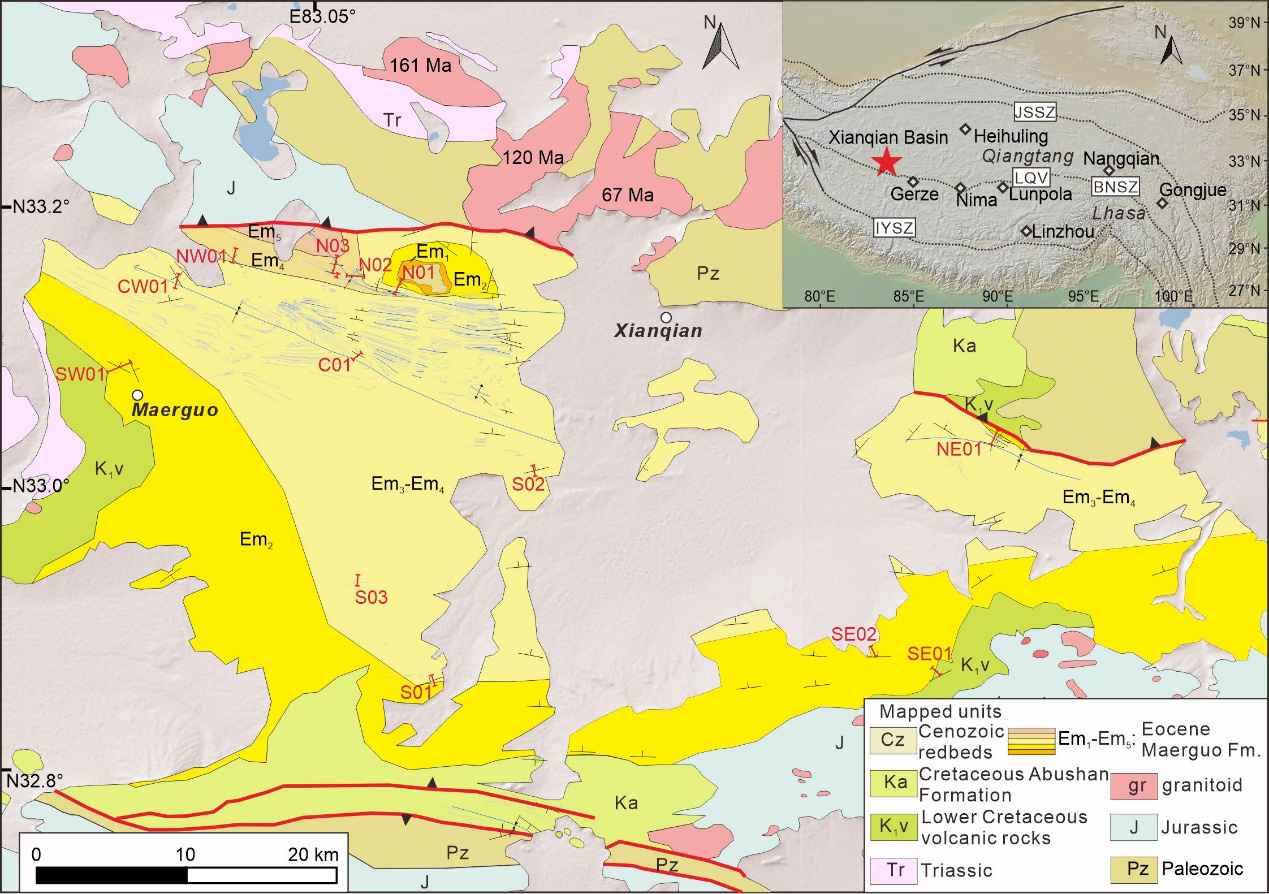
Figure 1. Tectonic setting and simplified geological map of the Xianqian Basin in the central Tibetan Plateau.
2.Mechanism: lithospheric dripping drove rapid uplift and southward expansion of Qiangtang
The basin’s elliptical geometry, short lifespan, synsedimentary shortening, abundant volcaniclastic deposits, arid climate, internally drained hydrologic system, and tectonic-subsidence history that shifted from slow to rapid subsidence collectively point to an intraplateau basin controlled by lithospheric dripping. These features are also consistent with predictions from geodynamic numerical models. On this basis, the researchers propose that the Qiangtang Terrane responded rapidly after the India–Asia collision, undergoing lithospheric dripping together with associated crustal shortening and thickening. These processes helped build plateau topography and drive its southward expansion.
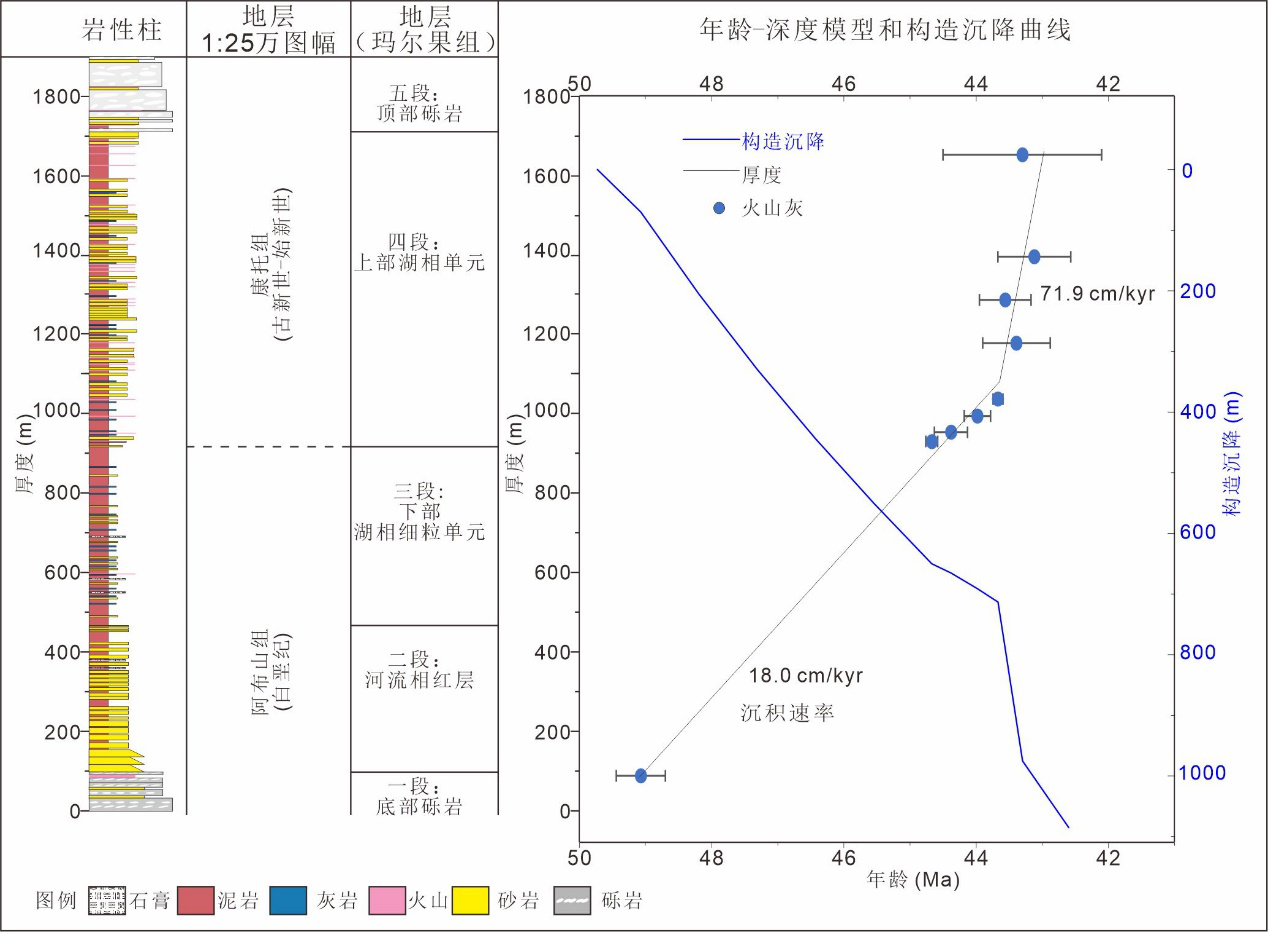
Figure 2. Eocene stratigraphic framework, age–depth model, and tectonic subsidence curve for the Xianqian Basin.
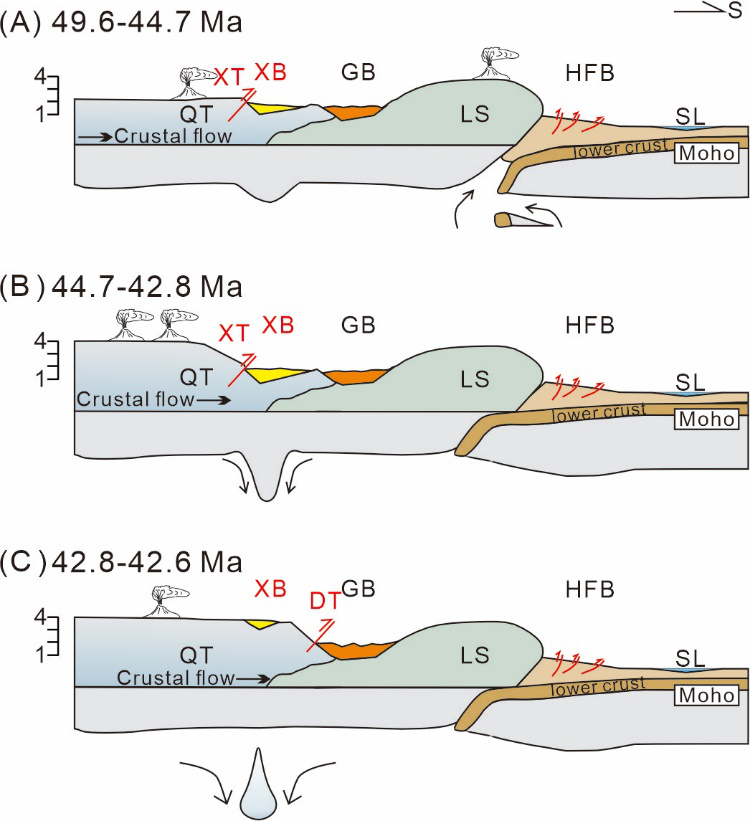
Figure 3. Paleogeographic and tectonic evolution of the central Tibetan Plateau from 50 to 43 Ma. XB: Xianqian Basin; GB: Gaize Basin; QT: Qiangtang; LS: Lhasa; HFB: Himalayan foreland basin.
3.A key question: can lacustrine carbonates be used for paleoaltimetry?
The Eocene paleoelevation of the Qiangtang basins is an active topic of research. Before lacustrine carbonates from the Xianqian Basin can be used to reconstruct the paleoelevation of the Qiangtang Terrane, a fundamental question must be answered: do these carbonates preserve the original oxygen-isotope signal of lake water or meteoric precipitation? To address this issue, the team investigated the basin’s burial history and diagenetic evolution.
Carbonate clumped-isotope temperatures from 16 micritic lacustrine dolomite samples taken from different stratigraphic levels range from 47 to 77 °C, clearly above surface temperatures. Determining why these temperatures are elevated is crucial for evaluating whether carbonate oxygen isotopes can be used reliably for paleoaltimetry. In the absence of fluid interaction, heating can induce solid-state reordering of clumped isotopes, increasing apparent clumped-isotope temperatures while leaving bulk oxygen isotopes unchanged. To test this possibility, the team conducted low-temperature thermochronology. Apatite (U–Th)/He ages at the base of the basin were fully reset, while apatite fission tracks were only partially annealed. Thermal-history modeling indicates that the basin reached a maximum burial temperature of about 106 °C at approximately 42 Ma, followed by rapid exhumation, and returned to near-surface conditions by around 34 Ma.
4.Conclusion: fluid-assisted dolomitization means oxygen isotopes cannot be used directly for paleoaltimetry
Further numerical modeling shows that the burial temperatures were insufficient for solid-state bond reordering to explain the elevated clumped-isotope temperatures. Petrographic, mineralogical, and geochemical evidence instead indicates that the lacustrine carbonates of the Xianqian Basin underwent fluid-assisted dolomitization during shallow burial. Fluid δ18O values calculated from clumped-isotope temperatures and carbonate oxygen-isotope compositions range from +1‰ to +6‰, recording diagenetic fluids rather than the original lake water or meteoric precipitation. The results demonstrate that oxygen-isotope compositions of lacustrine carbonates from the Xianqian Basin cannot be used directly for paleoaltitude reconstruction.
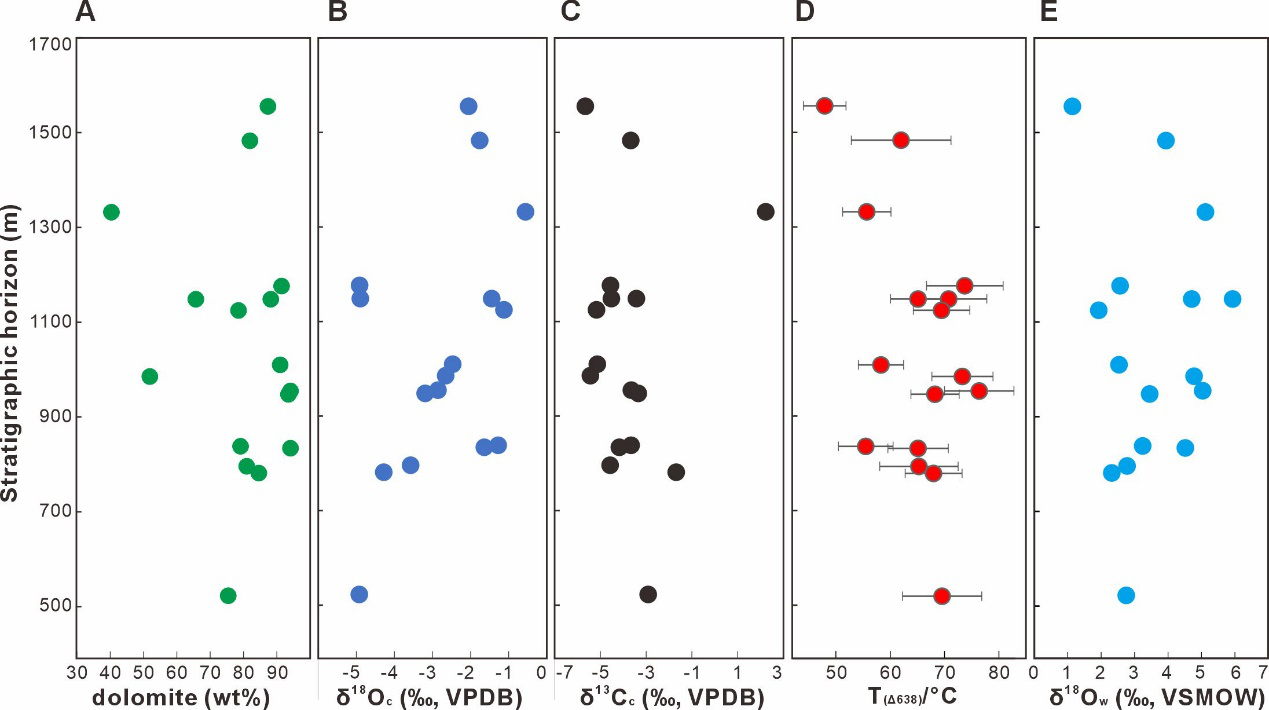
Figure 4. Stratigraphic variations in dolomite content, carbonate carbon and oxygen isotopes, clumped-isotope temperatures, and oxygen-isotope compositions of diagenetic fluids in the Xianqian Basin.
5.Implications: diagenetic alteration is widespread in Cenozoic lacustrine carbonates across the Tibetan Plateau
By comparing the Xianqian record with Paleogene continental basins at Linzhou, Gaize, Nima, Lunpola, Heihuling, Gonjo, and Nangqian, the team further argues that diagenetic modification of lacustrine carbonates is widespread across the Tibetan Plateau. Even when lacustrine carbonates retain apparently primary sedimentary features such as bedding and micritic textures, they may have undergone cryptic fluid alteration and dolomitization. Future studies using lacustrine carbonates to constrain Tibetan paleoelevation therefore need to evaluate diagenesis using multiple lines of evidence, including basin thermal history, clumped isotopes, petrography, mineralogy, and elemental geochemistry. In basins where carbonate diagenesis is pronounced, other independent paleoaltimetry proxies will need to be identified and developed.
Assistant Professor Anlin Ma of the School of Earth Sciences and Engineering at Nanjing University is the first author and a co-corresponding author of the studies, and Professor Xiumian Hu is the other co-corresponding author. The research was supported by the National Natural Science Foundation of China, the State Key Laboratory of Critical Earth Material Cycling and Mineral Deposits, and the Fundamental Research Funds for the Central Universities, among other sources.
6.Paper information
Ma, A., Li, L., Li, G., He, J.J.Y., Kapp, P., Lu, C., Zhang, H., Lin, C., Wang, J.W., Zheng, B., Li, K., and Hu, X. (2026). History of burial, carbonate diagenesis, and exhumation of the Eocene Xianqian Basin in western central Tibet.Earth and Planetary Science Letters, 695, 120328.https://doi.org/10.1016/j.epsl.2026.120328
Ma, A., He, J.J.Y., Hu, X., Kapp, P., Wang, Y., Wang, J.W., Li, L., Liang, W., Wang, X., and Li, K. (2026). Early to middle Eocene (50–43 Ma) Xianqian Basin in central Tibet: Archives of arid paleoenvironments and a southward plateau uplift trend.GSA Bulletin, 138, 1867–1892.https://doi.org/10.1130/B38437.1
Credits:Written by Anlin Ma and Xiumian Hu; reviewed by Zeng Gang. |
