
Published August 28, 2026 · School of Earth Sciences and Engineering, Nanjing University
How Earth’s earliest continental crust formed—and the tectonic setting in which it developed—remains a major frontier question in geoscience, with direct implications for understanding continental evolution and the onset of plate tectonics. At the center of the debate is the role of subduction and liquid water in generating Archean tonalite–trondhjemite–granodiorite (TTG) suites. Some models propose that TTG magmas formed through partial melting of hydrated subducted oceanic crust or lower arc crust, implying that some form of subduction and horizontal lithospheric motion was already active on the early Earth. Other models instead attribute TTG formation to nonsubduction settings, such as mantle upwelling or large impacts, implying that plate tectonics had not yet emerged.
Addressing this long-standing question, doctoral student Di Zhou, under the supervision of Professor Rongfeng Ge at the School of Earth Sciences and Engineering, Nanjing University, worked with collaborators in China and Australia to publish new findings in Science Advances. The study provides the first quantitative constraints on the oxygen fugacity and water content of Paleoarchean granitic magmas in Australia’s Pilbara Craton between 3.5 and 3.2 billion years ago. Both parameters show a progressive increase through time. This secular trend is difficult to reconcile with nonsubduction models, but is consistent with deep water recycling driven by subduction, providing important constraints on the transition in early-Earth tectonic regimes and the origin of continental crust.
The Pilbara Craton has long been regarded as a key natural laboratory for models in which Archean continental crust formed without subduction. Using a recently developed zircon oxybarometer-hygrometer (Ge et al., 2023, Nature), the team systematically reconstructed magmatic oxygen fugacity (fO₂) and water content (H₂O) in Paleoarchean granitoids from the eastern Pilbara Craton. The results show that between 3.5 and 3.2 billion years ago, magmatic fO₂ increased from about FMQ −1.0 to FMQ +1.4, while H₂O rose from 3.5 wt% to 9.5 wt% (Fig. 1). Notably, samples dated to 3.32–3.26 billion years ago record fO₂ and H₂O values approaching those of porphyry Cu-related granitoids in Phanerozoic subduction–collision belts.
Geochemical analyses and thermodynamic modeling indicate that this prolonged and pronounced shift toward more oxidized, water-rich magmas was not primarily controlled by crustal thickening and garnet fractionation. Instead, it reflects the progressive addition of oxidized and hydrous material to magma source regions, triggering water-fluxed melting (Fig. 2). Such observations are difficult to explain with existing nonsubduction models, including heat-pipe tectonics, mantle plumes, greenstone dripping (sagduction), or giant impacts. They are, however, consistent with deep, water-fluxed melting of arc crust driven by subduction-related water recycling. The study further proposes that mantle-upwelling-driven episodic subduction and crustal stacking may have been a key feature of a transitional geodynamic regime between stagnant-lid tectonics and fully developed plate tectonics.
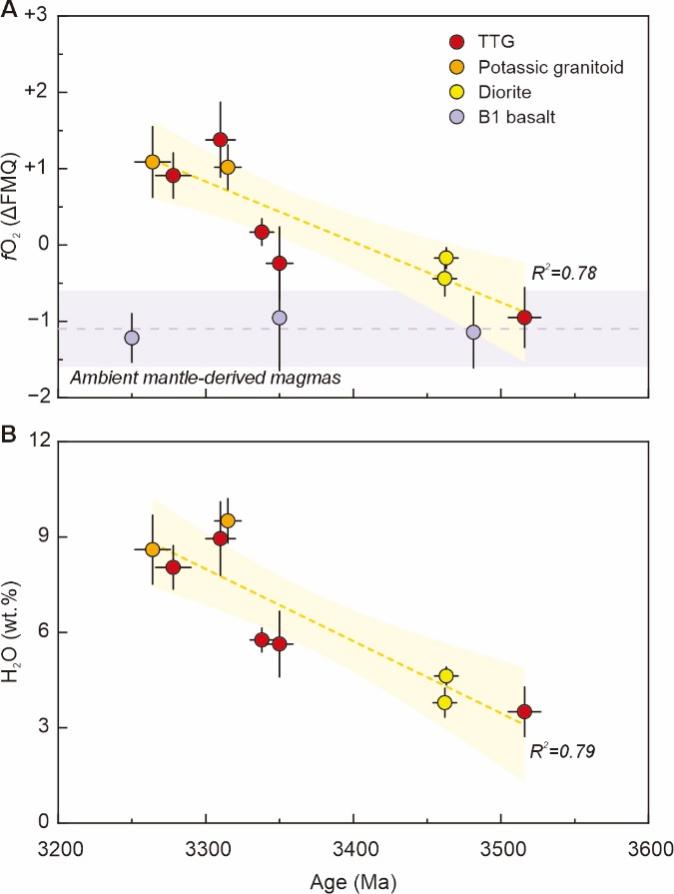
Figure 1. Temporal evolution of Paleoarchean magmatic oxygen fugacity (A) and water content (B) in the Pilbara Craton, Australia.
The paper, “Paleoarchean deep crustal hydration and oxidation induced by subduction-driven water recycling,” was published online in Science Advances on May 8, 2026. The study was led by Nanjing University in collaboration with Curtin University and The University of Western Australia. Di Zhou is the first author and Professor Rongfeng Ge is the corresponding author. Coauthors include Associate Professor Dongyang Lian, Dr. Pengjie Cai and Professor Xiaolei Wang of Nanjing University; Professors Simon A. Wilde and William J. Collins of Curtin University; and Professor Anthony I. S. Kemp of The University of Western Australia. The work was supported by the National Natural Science Foundation of China (42425204, 42372228), the National Key Research and Development Program of China (2023YFF0804404), and the National Science and Technology Major Project (2024ZD1001000).
Publication:Paleoarchean deep crustal hydration and oxidation induced by subduction-driven water recycling Science Advances 12(19), eaec1040 · DOI:10.1126/sciadv.aec1040 |
Thermodynamic–geochemical modeling
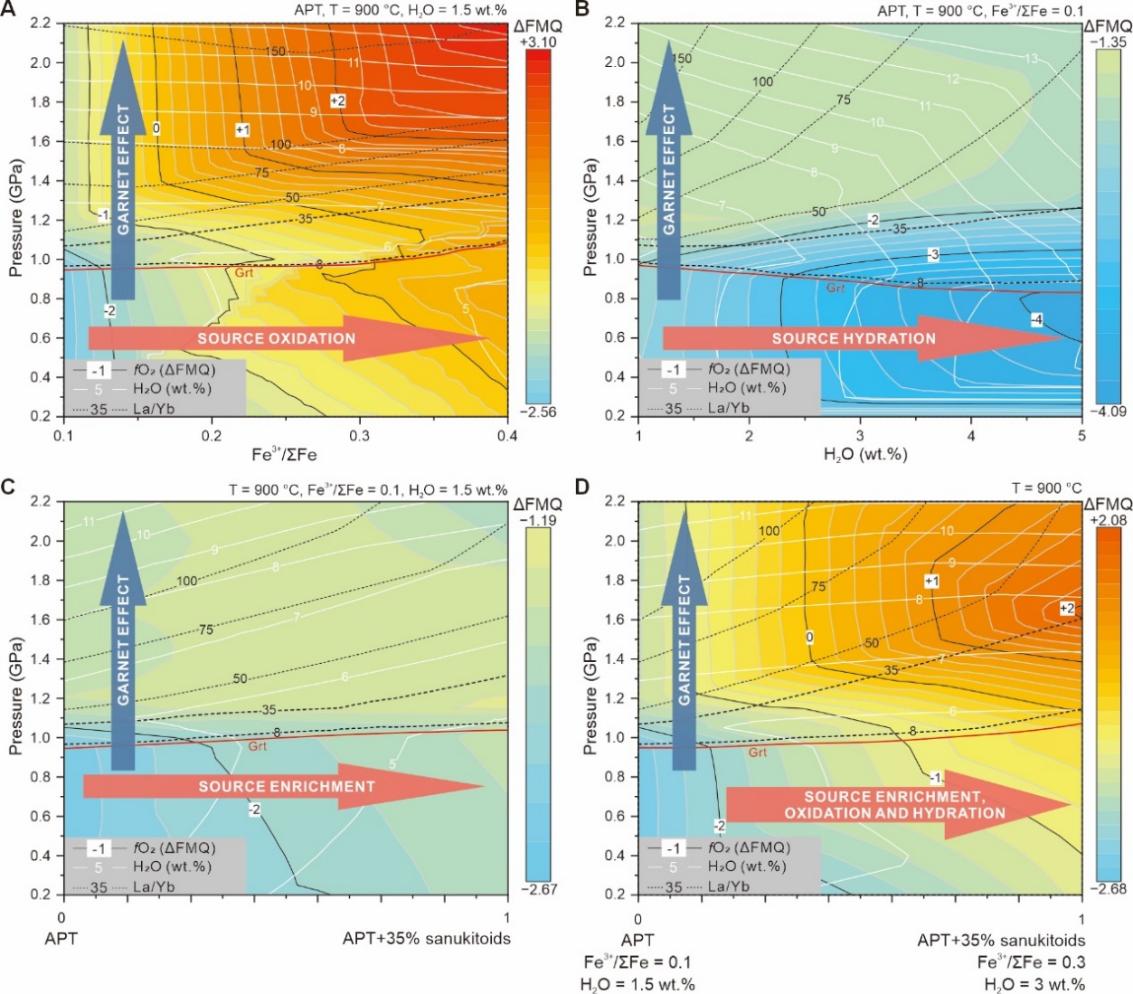
Figure 2. Thermodynamic–geochemical modeling of the factors controlling magmatic oxygen fugacity and water content.
Original Chinese news release: School of Earth Sciences and Engineering, Nanjing University · Text and figures: Di Zhou · Reviewed by Tianyu Chen
