
September 2, 2026 • School of Earth Sciences and Engineering, Nanjing University
The winners of the second Jiangsu Patent Awards were recently announced. An invention patent developed by a team led by Professors Shi Bin and Zhu Honghu at Nanjing University’s School of Earth Sciences and Engineering — “Slope Stability Monitoring and Landslide Early Warning and Forecasting Method Based on an All-Fiber Sensing Network” (Patent No. CN 106767476 B) — received the Jiangsu Patent Excellence Award.
Mountainous terrain accounts for more than two-thirds of China’s land area, and landslides occur frequently, posing serious threats to lives and property. Landslides fundamentally arise from the accumulation of deformation and progressive instability along engineering-geological interfaces within slopes. Conventional slope-monitoring methods often rely on surface-displacement measurements or borehole inclinometers. Such approaches can be susceptible to electromagnetic interference, have limited environmental adaptability and offer relatively low spatial resolution, making it difficult to accurately capture the evolution of multiple slip surfaces within a slope or to provide real-time quantitative assessments of slope stability.
To address these technical challenges, the patented technology introduces an integrated all-fiber-optic sensing tube. By embedding distributed fiber-optic sensing cables within a slope, the system enables real-time, high-precision and distributed sensing of multiple parameters, including strain and moisture fields. The team also established a quantitative conversion model linking characteristic strain values to the slope factor of safety. Using real-time monitoring data, the system can dynamically assess slope stability and precisely locate slip surfaces from abrupt changes in strain, while supporting the simultaneous identification of multiple slip surfaces. The technology therefore provides a new approach to proactive landslide warning and early risk prevention.
Prototype development was supported by the National Natural Science Foundation of China, the National Basic Research Program of China (973 Program) and the National Key Technology R&D Program. Technical development and multiple rounds of refinement were carried out with support from the Jiangsu Engineering Research Center for Geo-Sensing and Disaster Control and the Nanjing University Center for Optoelectronic Sensing and Engineering Monitoring. The technology has been widely applied in major national engineering projects and areas at high risk of geological hazards, including the Three Gorges Reservoir region, the Sichuan–Tibet transportation corridor and China’s southeastern coastal areas.
The achievement reflects the School’s sustained progress in intelligent monitoring and early warning for geological engineering and represents one of its contributions to China’s national strategy for disaster prevention and mitigation.
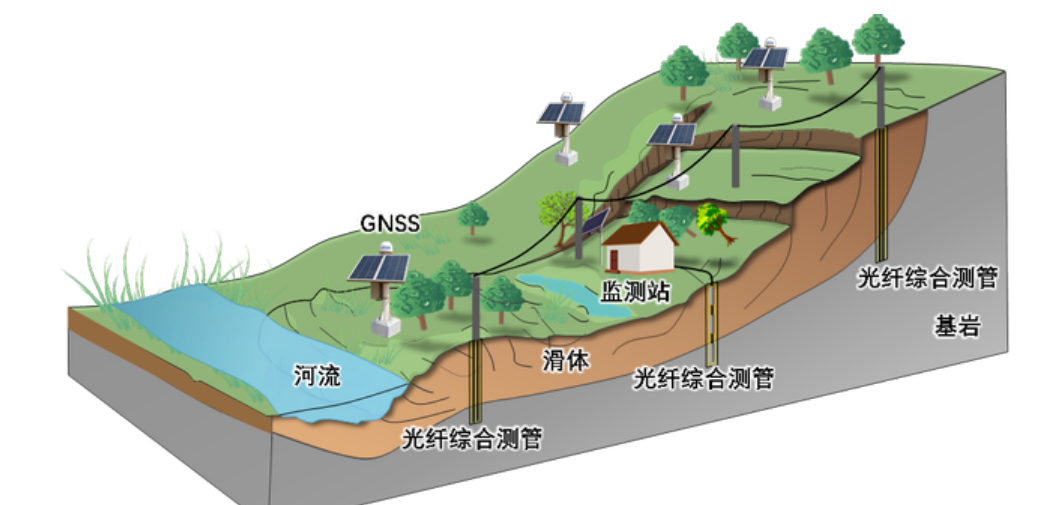
Figure 1. Schematic of the slope-stability monitoring and early-warning system based on an all-fiber-optic sensing network. Original figure labels are in Chinese.
Source:School of Earth Sciences and Engineering, Nanjing University.
