
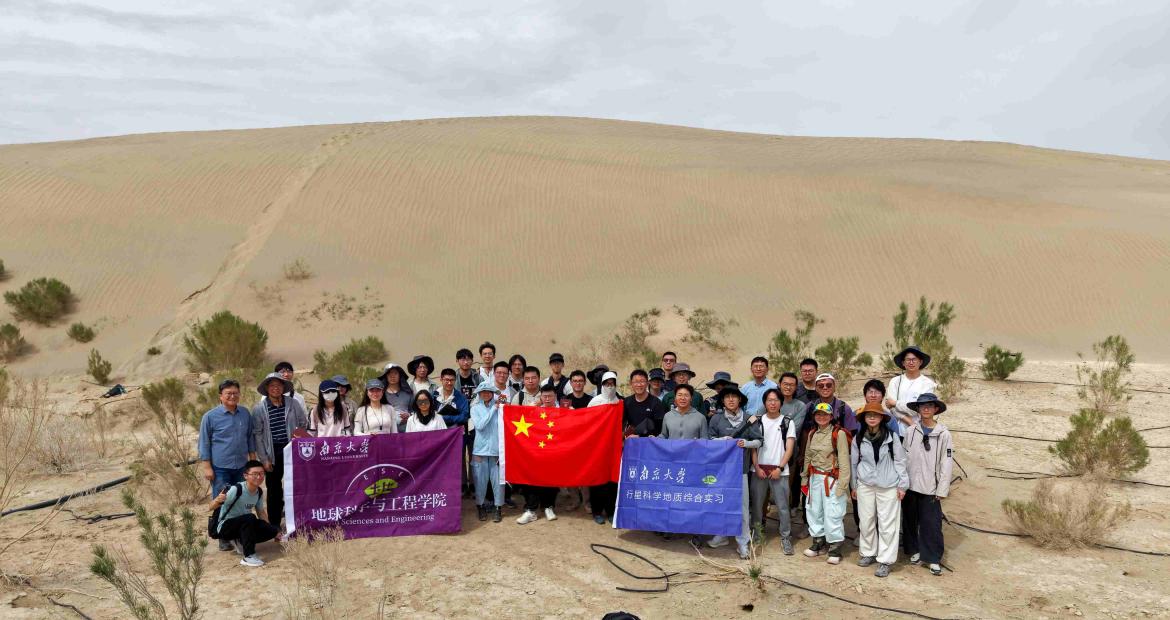
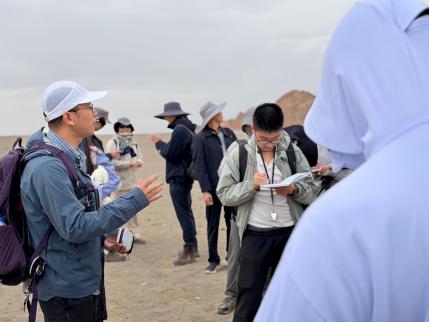
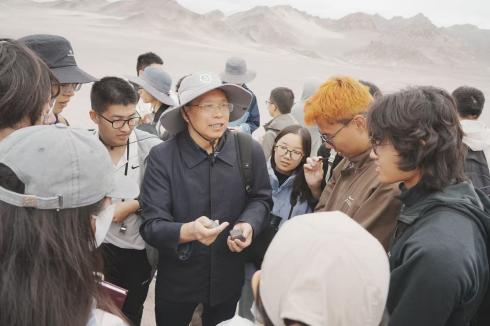
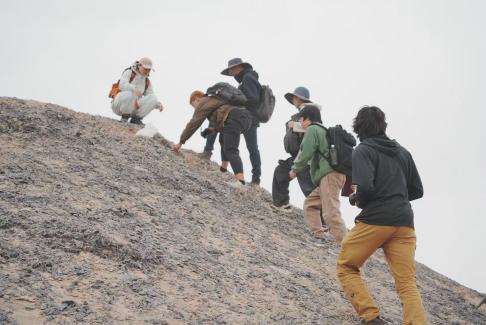
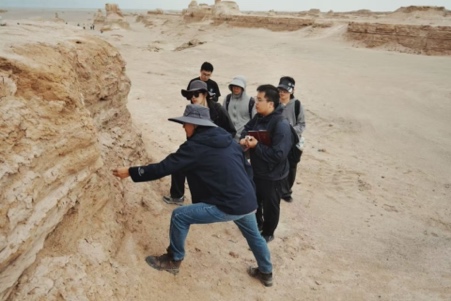
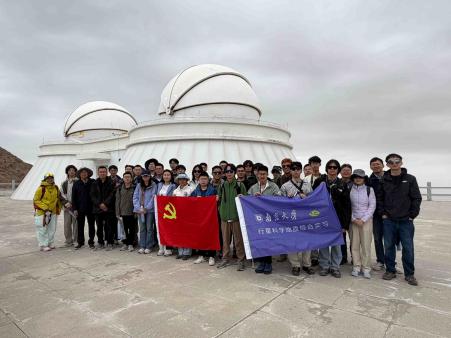
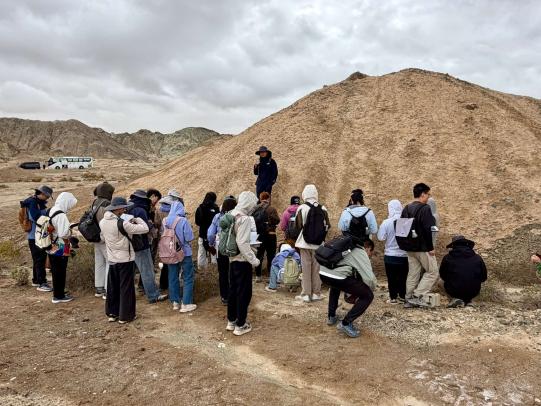
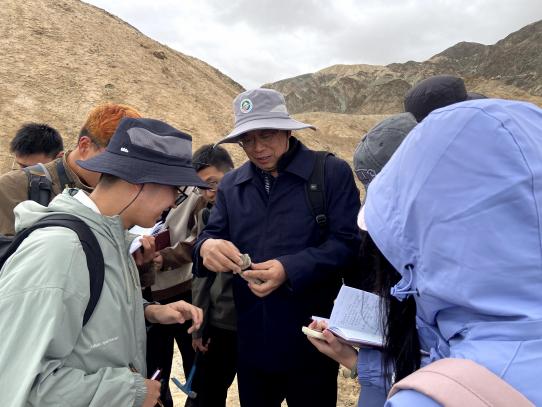
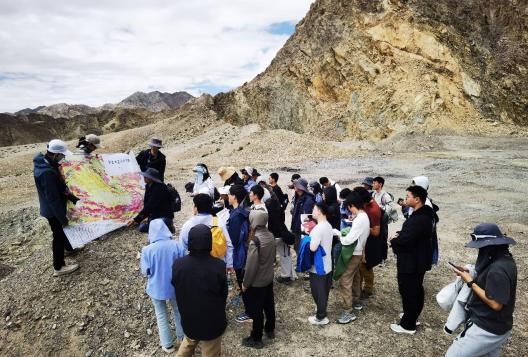
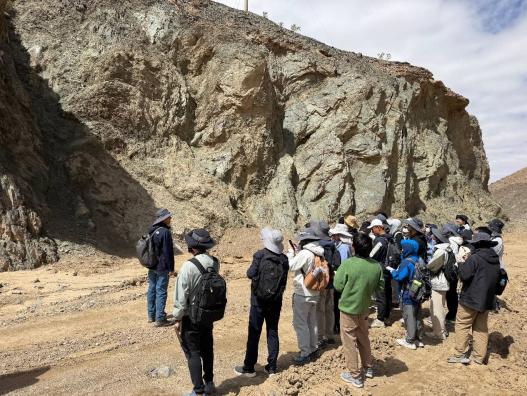
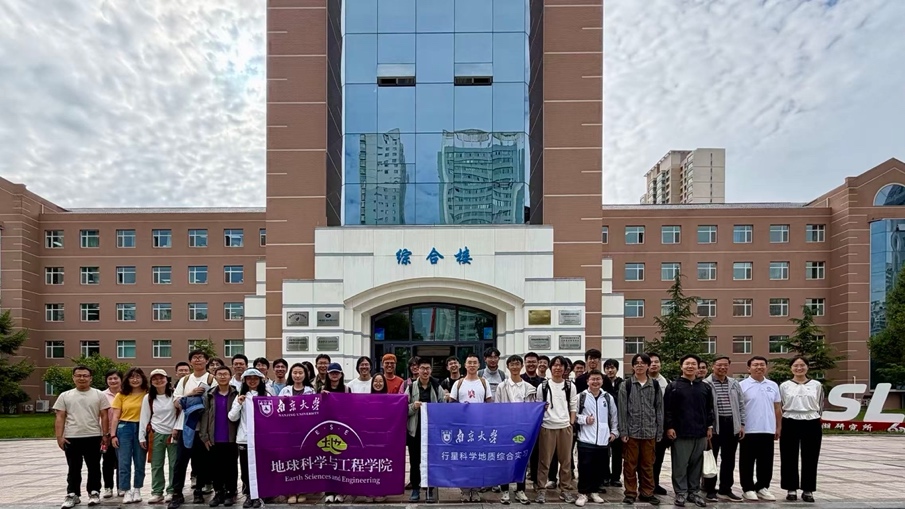
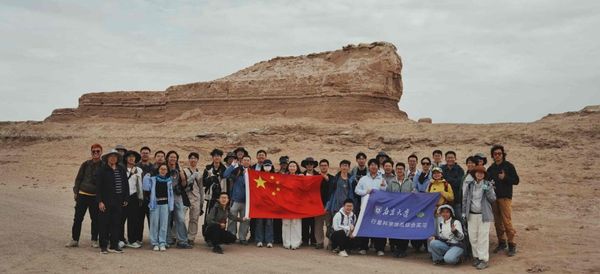
From July 6 to 15, the School of Earth Sciences and Engineering organized its first comprehensive planetary geology field trip for 31 undergraduate students from the 2023 and 2024 cohorts majoring in planetary science. The expedition traversed the Qaidam Basin, traveling through Dunhuang, Aksai, Lenghu, Dachaidan, and Xining in Gansu and Qinghai provinces. The comprehensive investigation focused on typical geological phenomena including sand dunes, yardangs, fault zones, riverbeds, salt lakes, and various rock profiles.
Planetary Science is a newly established undergraduate major at the school, introduced in 2023 to meet the national development needs for deep space exploration. As the first iteration of this compulsory professional course, the field trip was guided by a team of seven teachers: Assistant Professor Cao Cheng (Captain), Associate Professor Xie Hao (Vice-Captain), Professor Xu Xisheng, Professor Yang Yanhong, Associate Professor Yan Hao, Assistant Professor Liu Hanyong, and Teacher Du Yun from the experimental teaching center. The trip took a multidisciplinary approach, integrating geomorphology, sedimentology, tectonics, petrology, mineralogy, geochemistry, and astronomy to cultivate students' cross-disciplinary analytical and scientific inquiry skills.
Searching for Stars in the Sea of Sand: Finding Martian Traces in Desert Landforms
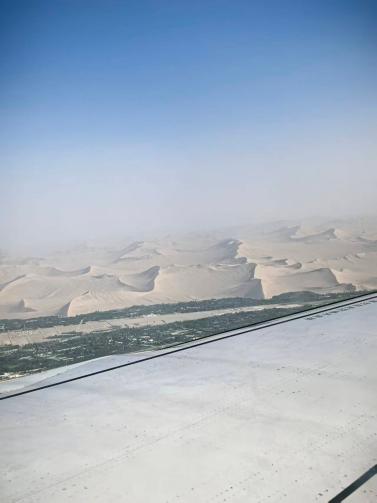
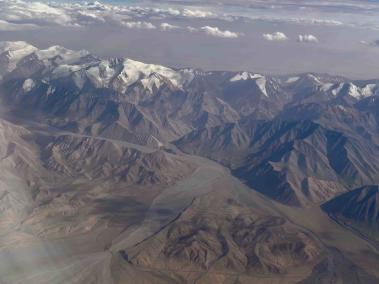
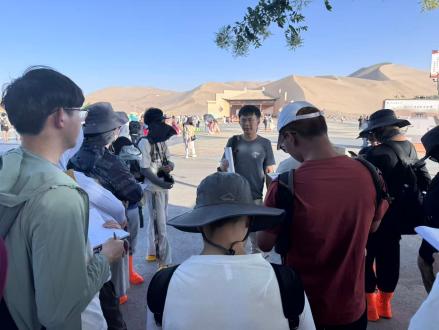
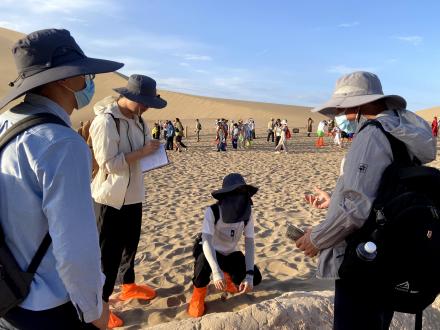
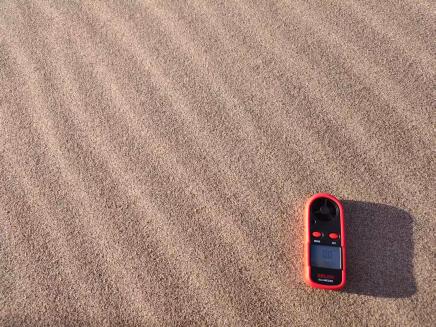
The scientific journey began on July 6 en route to Dunhuang, where students observed star dunes, barchan dunes, and alluvial fans from the airplane window. These landforms, which also widely exist on the surface of Mars, serve as important subjects for comparative planetary research. At Mingsha Mountain, students measured dune ridge lines and slope attitudes, analyzed wind-driven transport and deposition processes, and compared the similarities and differences of dune formation and evolution between Earth and Mars.
Decoding Paleo-environments and Sediments
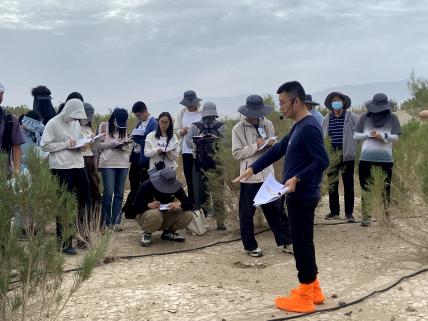
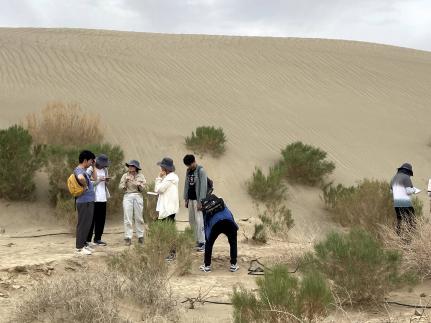
On July 8, the team explored the Aksai paleo-lake bed. By observing sedimentary grain size variations, mud cracks, and mineral assemblages, students inferred the region's transition from a lake to a modern desert and considered the connections between paleo-lake evolution and ancient Martian water environments.
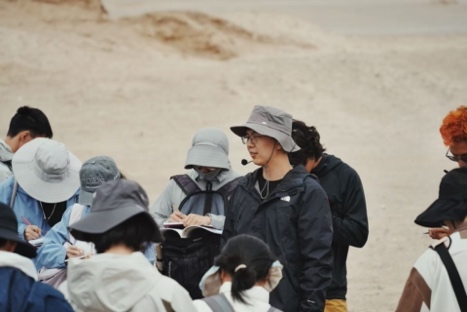
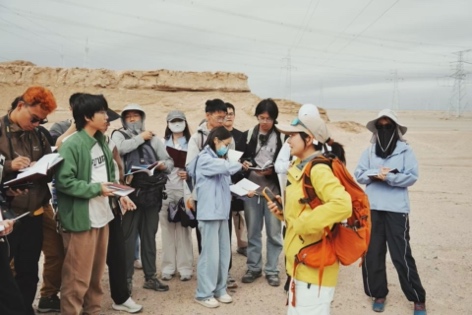
The following day at the Lenghu Yardang landform area, students measured yardang morphologies and sketched field observations to reconstruct paleo-wind directions and explain the formation of different yardang shapes. They observed differential weathering, salt weathering, and modern mud cracks, comparing these Earth landscapes to similar Martian features.
Tracing Earth's Evolution from Rock Outcrops
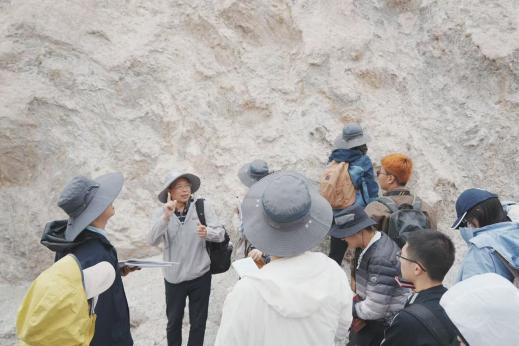
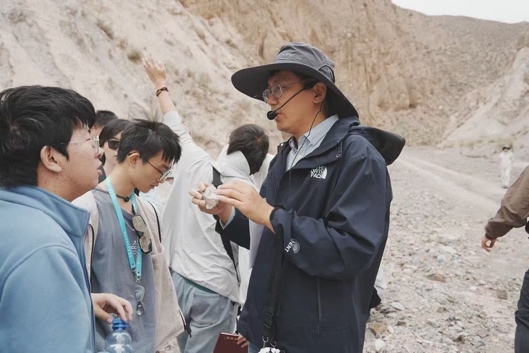
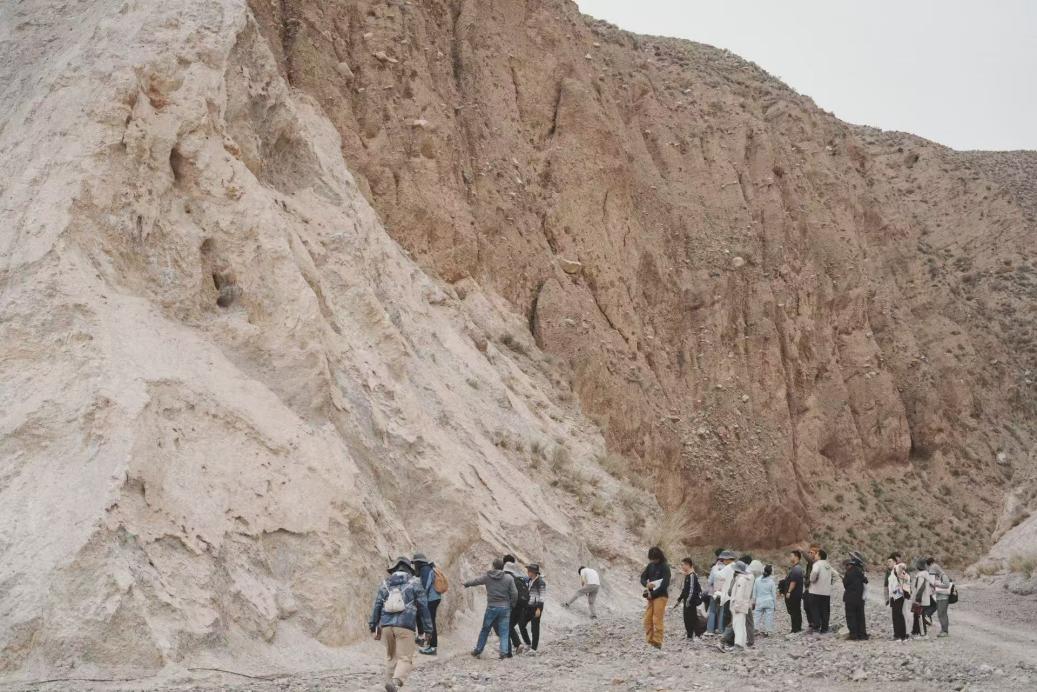
While crossing the Altyn Tagh Mountains, the team investigated the Altyn Tagh fault zone, combining satellite imagery with field evidence like tectonic lenses and active faults to understand the impact of large-scale faults on regional environmental evolution.
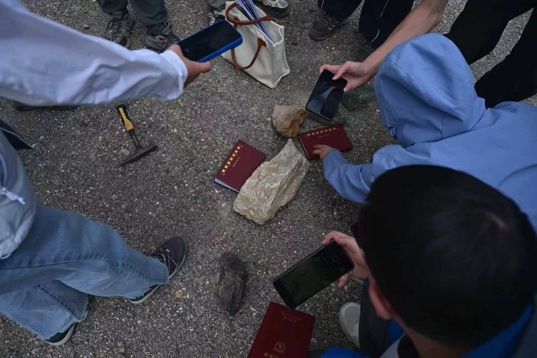
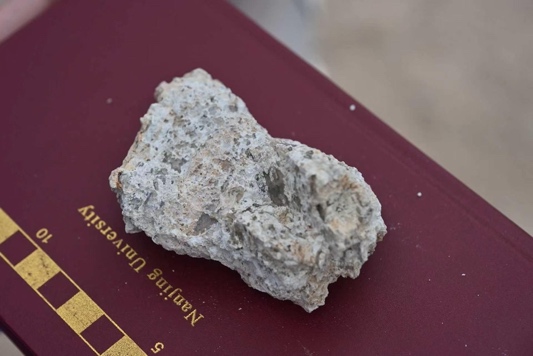
At Heidu Mountain, known as the "most moon-like place," students investigated why the mountain appears black. Through field verification, they learned that the color is primarily due to dark andesitic igneous rock, allowing them to compare Earth's physical weathering with lunar space weathering. The team also conducted comprehensive petrological investigations at Luofengpo and Xitieshan, identifying typical rocks like garnet amphibolite and marble to build multi-scale analytical capabilities.
Expanding the Vision of Comparative Planetology
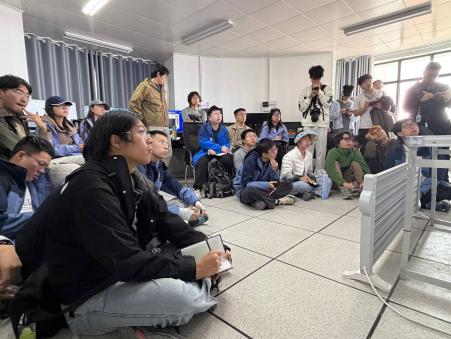
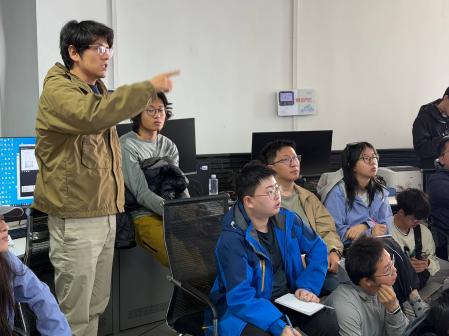
On July 9, the team overcame high altitude and cold to visit the Lenghu Saishiteng Mountain Observatory at an elevation of 4,200 meters, where researchers from the Chinese Academy of Sciences (CAS) introduced planetary telescopes and high-precision solar magnetic field measurement projects.
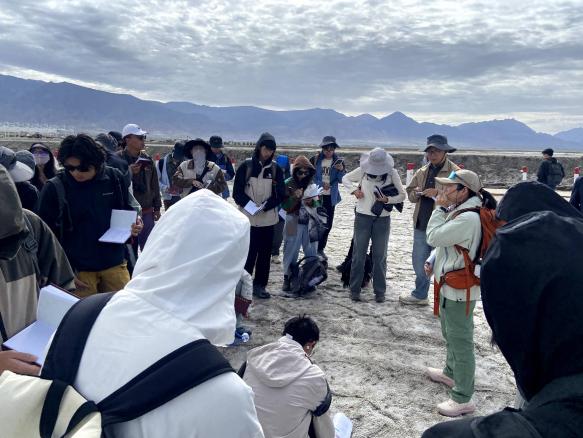
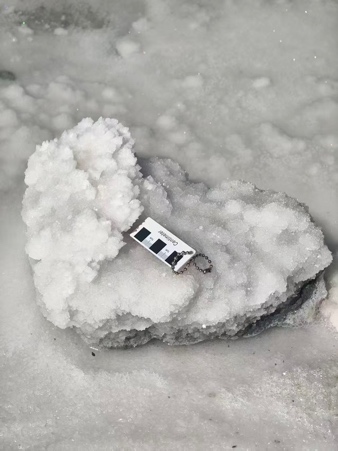
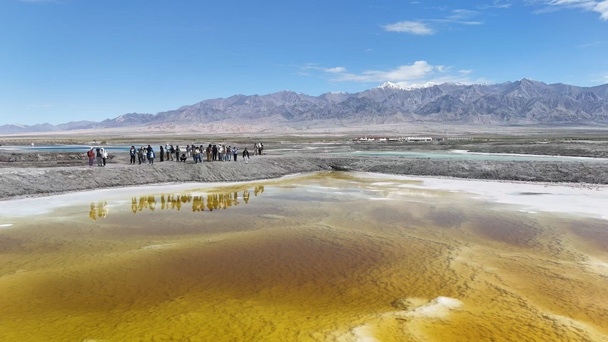
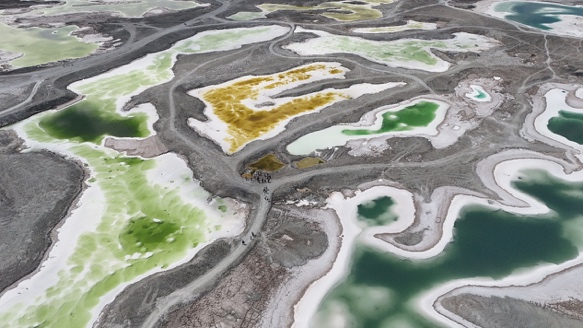
From July 12 to 14, the team investigated the Dachaidan Emerald Lake and Qinghai Lake. Students observed dry salt flat polygons, salt crystals, and algal mats, comparing the salt lake sedimentary processes with layered deposits and evaporite minerals found in ancient Martian lakes.
A Walking Classroom: The Spirit of Scientific Dedication
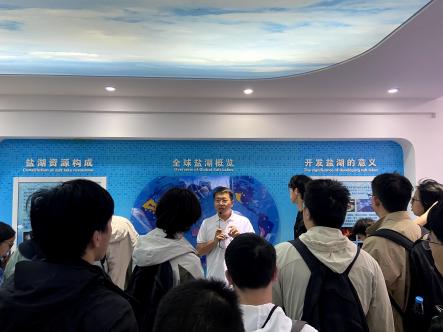
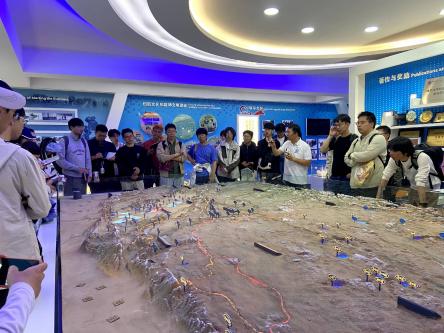
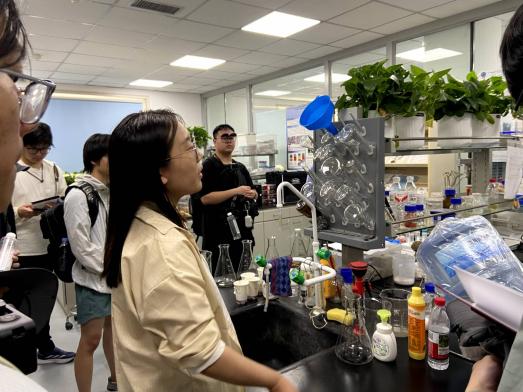
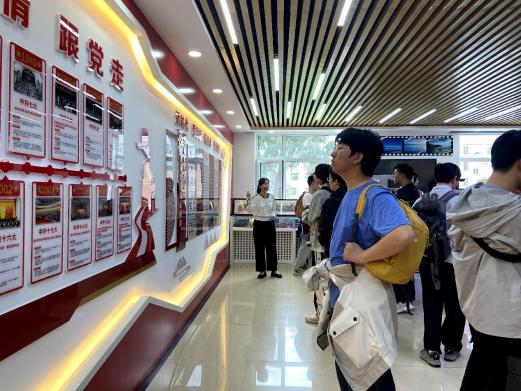
The field trip also included visits to the CAS Qinghai Institute of Salt Lakes, the Dunhuang Academy's national engineering research center for ancient mural protection, the Lenghu petroleum town ruins, and the Qinghai Lake torpedo test base. These visits provided profound ideological and political education, allowing students to experience the "Salt Lake Spirit" and the dedication of generations of scientists working in the harsh western regions to serve national needs.
Successful Conclusion and Future Prospects
The team safely returned to campus on July 15, having traveled thousands of kilometers over 10 days, overcoming challenges such as high temperatures, drought, large temperature differences between day and night, high-altitude hypoxia, and long treks.
Student Reflections: Strengthening the Original Aspiration to Explore the Stars in Practice
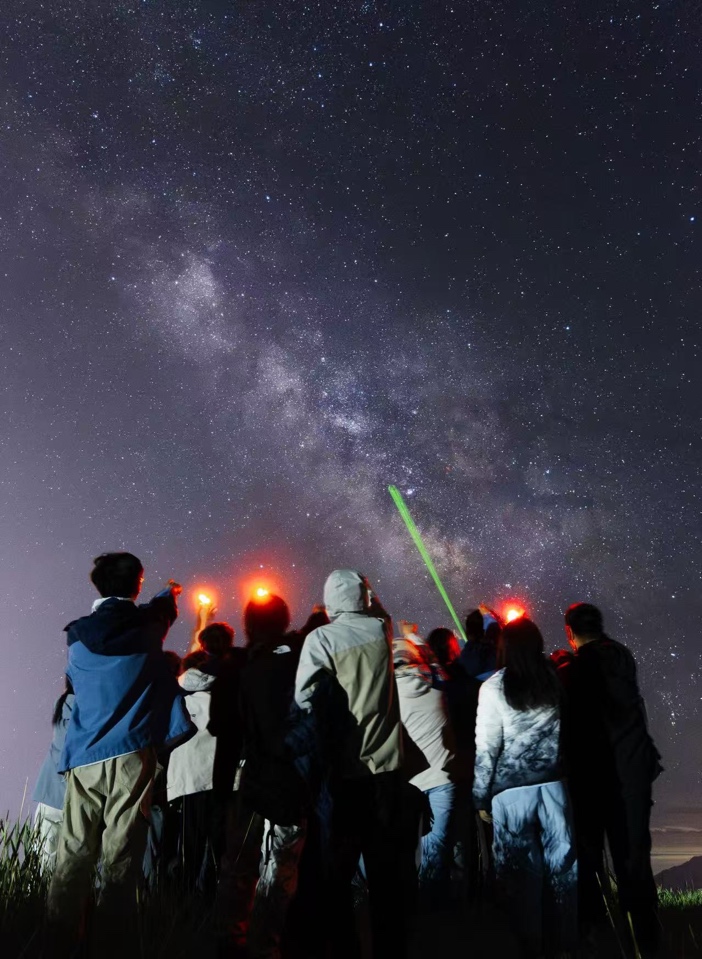
Zhang Xiurong (Class of 2024): "This Qinghai-Gansu field trip was a dialogue across Earth and the universe. Walking through Heidu Mountain and the yardang landforms felt like strolling on an alien surface, allowing me to intuitively feel the vicissitudes and magnificence of planetary geology. The profoundness of the Mogao Caves showcased Earth's unique beauty. The most unforgettable moment was stargazing in the Qaidam Basin, where the vast wilderness intertwined with the brilliant Milky Way. This practice not only brought textbook theories to life but also awakened my awe for the vast universe, strengthening my original aspiration to explore the sea of stars."
Cao Zhe (Class of 2024): "This grand Qinghai-Gansu loop field trip connected high mountains, basins, grasslands, lakes, and vast gobies. The magnificent landscapes along the way were breathtaking. Being in it, I not only felt the visual impact but also realized the greatness of natural forces shaping Earth's landscapes. I am grateful to the school for providing this precious practical platform and to the teachers for their careful guidance and hard work along the way."
Zhan Ningli (Class of 2024): "During this internship, I didn't experience significant altitude sickness, but seeing many teachers and classmates affected by the plateau environment made me truly understand the harshness of the Mars-like environment in the Qaidam Basin. When I learned that generations of scientific and technological workers had worked hard here for geological exploration, resource development, and scientific construction, I sincerely paid tribute to the researchers and builders deeply rooted in the plateau."
Mao Danwen (Class of 2023): "Re-understanding the grand Qinghai-Gansu loop from a planetary science perspective, every landscape along the way told the story of Earth's evolution. Identifying metamorphic rocks in the gobi and Luofengpo, observing landforms during the long drives, and manually looking for evidence and analyzing causes allowed me to truly experience the joy of scientific exploration. This field trip is a precious experience in the study of the planetary major."
Miao Yan (Class of 2023): "Heidu Mountain left the deepest impression on me. Before the internship, we repeatedly studied the concept of 'desert varnish,' but after on-site observation, we found that the black color of the mountain mainly comes from dark igneous rocks. Through careful observation, constantly looking for evidence to verify our speculations, we finally formed a reasonable explanation. This process of making bold hypotheses and carefully seeking proof made me deeply feel the charm of scientific research."
Moving forward, the school will continue to advance the construction of the planetary science major, utilizing the rich geological resources of Northwest China to cultivate innovative talents for the nation's deep space exploration endeavors.
