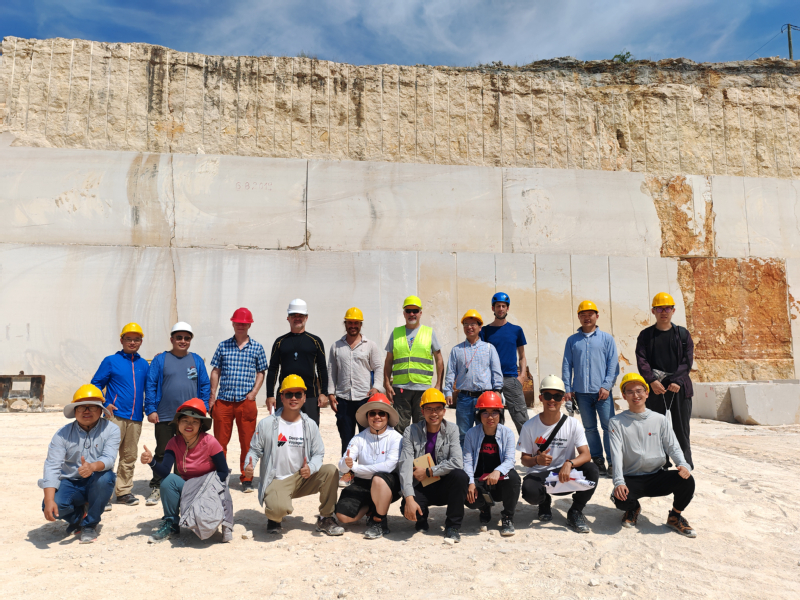
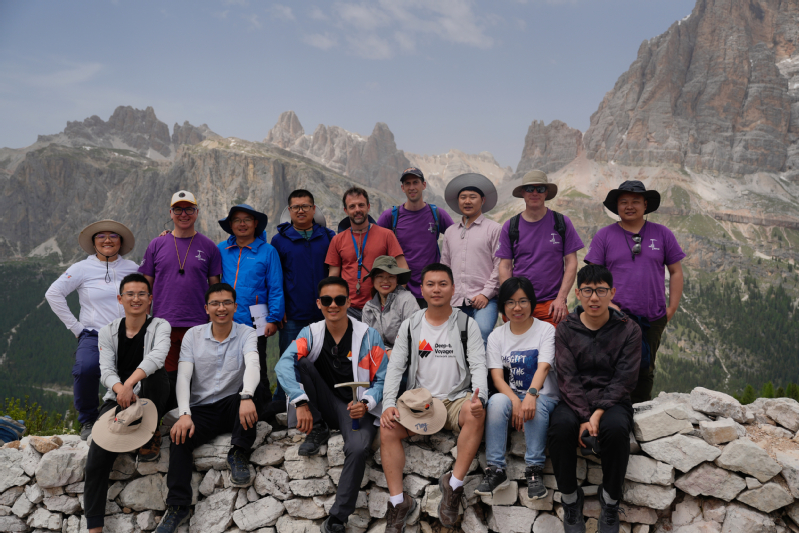
In Croatia (17th June – 19th June)
Field leader: Prof Igor Vlahović (Professor at University of Zagreb)
Description: The first part of the field trip will focus on the Toarcian Ocean Anoxic Event (TOAE), OAE1a and OAE2 sections in Velebit Mt., Gorski Kotar and Istria of Croatia. The Adriatic Carbonate Platform (AdCP) is one of the largest Mesozoic carbonate platforms of the Peri-mediterranean region. Its deposits comprise a major part of the entire carbonate succession of the Croatian Karst (External or Outer) Dinarides, which is very thick (in places more than 8000 m), and ranges in age from the Middle Permian (or even Upper Carboniferous) to the Eocene. The deposits ranging from the top of the Lower Jurassic (Toarcian) to the top of the Cretaceous can be attributed to the AdCP (defined as an isolated palaeogeographical entity), with the successions of the T-OAE, OAE1a and OAE2 profiles well exposed in Velebit Mt., Gorski Kotar and Istria of Croatia.
Saturday 17th June: Depart from Dubrovnik; Visit T-OAE section in Velebit Mt.
Velebit section (Sabatino et al., 2013)
The Pliensbachian is usually referred to as the ‘lithiotid limestones’ because of the presence of abundant bioclasts and complete shells of lithiotid bivalves. This unit, c. 200 m thick, includes rhythmic alternations of 20–80 cm thick layers of calcareous mudstones or pelletal wackestones with ooid packstones/grainstones and rare lithiotids in its lower to middle part, and wackestones/packstones and lithiotid or lithiotid/brachiopod floatstones/rudstones primarily in the upper part. The Toarcian is characterized by ‘spotted limestones’, which are similar to coeval rocks cropping out in the Alps, because of their spotted appearance largely resulting from very intense bioturbation of the soft sediment. This unit, generally 100–130 m thick, contains 5–20 rarely up to 60-cm-thick limestone layers with irregular bedding planes which are especially prone to weathering. The spotted limestones are mostly composed of more or less recrystallized calcareous mudstones and pelletal wackestones including interbeds of wackestones/packstones with bivalve bioclasts, centripetally micritized cortoids, peloids, echinoderms, ostracods, benthic foraminifera and some ooids. The grainy intervals are more common in the lowermost part of the unit. The characteristic negative carbon-isotope excursion (CIE) was recorded in the transitional interval of ‘lithiotid limestones’ and ‘spotted limestones’. The facies change of these two intervals are abrupt, representing an abrupt sea-level rise, which broadly correspond to the onset of the T-OAE negative CIE.
Sunday 18th June: Visit OAE2 section in Gorski Kotar
Gorski Kotar (Vlahovic´ et al., 2005)
The platform of the Early Cenomanian was characterised by the existence of different blocks, i.e., a subsequently more complex palaeogeographical pattern including emerged areas, shallow-water environments, carbonate ramps and deeper intraplatform troughs. The AdCP suffered temporary drowning around the Cenomanian/Turonian transition which was recorded over a major part of the platform.
Monday 19th June: Visit OAE1a section in Istria; arrive in Trieste, Italy in the evening
Kanfanar Section (Huck et al., 2010)
The massive lagoonal facies of the Lower Aptian (informal) Kanfanar Unit is characterized by a rhythmical alternation of mudstones/wackestones and oncoidal Lithocodium–Bacinella floatstones. The lower part of this unit, the Sv. Petar Member, is up to 20 m in thickness and characterized by a cyclic alternation between mudstone and Lithocodium–Bacinella floatstone that records changes from higher to lower sedimentation rates. This member also contains rudist-rich floatstones at the base (lower rudist level). The upper part of the Kanfanar Unit (Begovac Member) is restricted to the central part of Istria (Kanfanar Section). The Begovac Member consists of (rudist) shell floatstones (termed ‘upper rudist level’ throughout this study) and (algal) wackestones. The overlying megasequence boundary is represented by a succession of subaerial exposure surfaces, palaeosoil with deep-cutting karst features, representing astratigraphic gap from the Early/Late Aptian to the Early Albian. Chemostratigraphic data from the studied sections (carbon-isotope and strontium-isotope stratigraphy) are largely consistent with existing biostratigraphic results and place the Istrian Lithocodium–Bacinella facies at the onset of ocean-wide anoxic event 1a, specifically in the chemostratigraphic segment C3 (the large negative excursion of the δ13C).
Part II: In Italy (20th June – 21st June)
Field leaders:
Dr. Marco Franceschi (Associate Professor at University of Trieste) mfranceschi@units.it
Dr. Alberto Riva (Research Fellow, University of Ferrara) alberto.riva@unife.it
Description: This part of the field trip will focus on the evidence of the Toarcian Ocean Anoxic Event (T-OAE) and the Carnian Pluvial Episode (CPE) exposed in the central Dolomites of Italy. The Dolomites expose a thick, often exceptionally exposed, Mesozoic sedimentary succession whose Upper Triassic – Lower Jurassic portion mainly comprises carbonate rocks that deposited in platform to basin settings. Rocks register a complex paleogeographic evolution of the area that was located a tropical latitude during the break-up of Pangea. The evidence of the T-OAE is well exposed in the vicinity of the town of Longarone where it is testified by black-shales within the Igne Formation. The CPE is exposed in the surroundings of Cortina, where it is possible to appreciate the demise of high relief carbonate platforms that thrived in the area and the filling of the surrounding basins by siliciclastic sediments deposited during the CPE. An extra stop of the field trip will be visiting the Vajont dam and landslide, theatre of a catastrophe in 1963 that costed the lives of 2000 people.
Tuesday 20th June: Departure from Trieste and drive to Longarone to visit T-OAE sections. Overnight between Longarone and Cortina
We will visit three sections exposing the Toarcian rocks in the Longarone area; Vajont gorge section; Longarone section; Rizapol section
During the Early Jurassic, the Longarone area was located in the Belluno Basin, a deep water sedimentary basin that stretched in approximately N/S direction in between two areas of shallow water carbonate production: the Trento Platform to the W and the westernmost portion of the Adriatic Carbonate Platform to the East. The Lower Jurassic stratigraphic units are mainly composed of cherty limestone associated in variable proportion with marls and calcarenite lithologies. The physical expression of the T-OAE is found in the Igne Fm., which comprises well-bedded cherty limestone/marl alternations, and is represented by a 9 to 12.5 m-thick interval of black laminated shales. Such black shales hold a special place in the study of the T-OAE because the available sections are well calibrated with biostratigraphic data, both from ammonites and nannofossils, allowing to resolve in detail the duration of the T-OAE.
After completing the visit of the stops dedicated to the T-OAE, we will transfer to the village of Casso, which is located above the Vajont dam. The Vajont dam is a large infrastructure built in the early 1960s. At the time of its construction the dam was the tallest in the world of its type. On the night of October 9th 1963, a massive landslide fell from the slopes of the mountains located to the south of the dam basin. This caused catastrophic waves that destroyed villages that stood around the lake and in front of the dam, including the town of Longarone. Nearly 2000 people lost their lives. From the village of Casso it is possible to have a spectacular view of the huge landslide. On the sixtieth anniversary of the tragedy, we think that memory of this event is a must, for geologists in particular as it represents a warning and a reminder of the responsibility they can carry with their work.
Wednesday 21ST June: Visit CPE section around Cortina; Return to Trieste in the evening.
The Carnian Pluvial Episode (CPE, ∼233 Ma) was characterised by multiple negative carbon-isotope excursions, turnovers in marine and terrestrial biota, and a Tethys-wide humid climate accompanied by abundant terrigenous sediment and freshwater input into sedimentary basins. A general temporal coincidence between the CPE and the emplacement of the Wrangellia Large Igneous Province (Wrangellia LIP) has been well documented. The Carnian sedimentary succession of the Dolomites is where the isotope perturbation characteristic of the CPE was first highlighted. The stratigraphic framework comprises shallow-water and basin units that reflect the existence of an articulated physiography characterised by high-relief carbonate buildups (“Cassian” platforms) surrounded by deep basins. Things changed profoundly with the CPE, here represented by the Heiligkreuz Formation, when carbonate platforms demised, where subaerially exposed and large volumes of siliciclastic filled the intra-platform basins. In the Cortina area we will visit the Passo del Falzarego section where it is possible to observe the demise, exposure and later drowning of the Cassian platform. Hence, we will transfer via chairlift to the Cinque Torri where it is possible to have a comprehensive panorama video of the sequence of events that in the area characterise the CPE.
Thursday 22nd June: Departure from Trieste
Field participants of IGCP 739 in Croatia and Italy | |||
No | Name | Affiliation | |
1 | Zhicai Zhu | zzccugb@126.com | University of Bristol |
2 | Xiumian Hu | huxm@nju.edu.cn | Nanjing University |
3 | Xi Chen | xichen@cugb.edu.cn | China University of Geosciences, Beijing |
4 | Xin Jin | jinxin2012cdut@163.com | Chengdu University of Technology |
5 | Zhong Han | hanzhong19@cdut.edu.cn | Chengdu University of Technology |
6 | Juan Li | juanli@nigpas.ac.cn | Nanjing Institute of Geology and Palaeontology |
7 | Tianchen He | tianchenhe@hhu.edu.cn | Hohai University |
8 | Jingxin Jiang | jjxcug24@163.com | Nanjing University |
9 | Hang Jiang | HANG.JIANG@phd.units.it | Università degli Studi di Trieste |
10 | Robert Newton | r.j.newton@leeds.ac.uk | University of Leeds |
11 | Parisa GholamiZadeh | prsgholami@gmail.com | Institute of Geology and Geophysics, Chinese Academy of Sciences |
12 | William Foster | W.J.Foster@gmx.co.uk | University of Hamburg |