


1. Invitation
The International Workshop on Mesozoic–Palaeogene Hyperthermal Events & Fifth IGCP 739 Workshop will be held on August 16–18, 2025 at Nanjing University, Jiangsu, China. The workshop is open to anyone from a university, research institute, or industry, and we cordially invite you to participate.
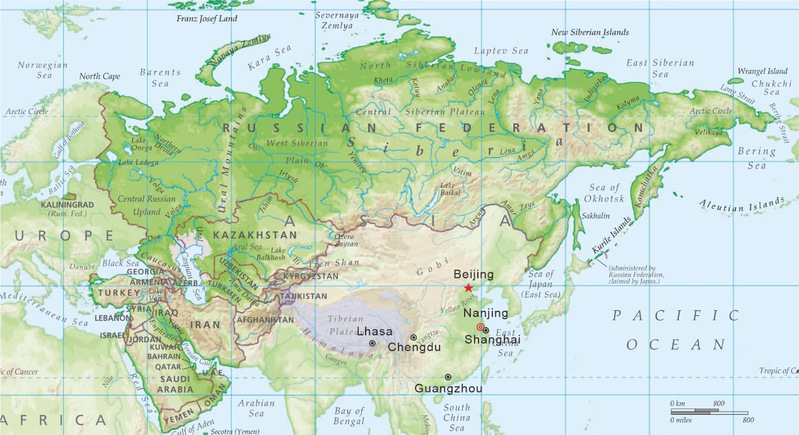
Nanjing is located in eastern China on the Yangtze River, approximately 300 kilometers west of Shanghai. It is the capital of Jiangsu Province. Historically, Nanjing is known as one of China’s ancient capitals, serving as “Ancient Capital of the Six Dynasties” and the “Capital of the Ten Dynasties”, including the early Ming dynasty and the Republic of China. It is recognized by China as a national central city and an important cultural and historical city and also designated as a core city for innovation and modernization in eastern China. Nanjing’s cultural appeal is evident in its renowned landmarks, such as the Sun Yat-sen Mausoleum, the Confucius Temple, the Nanjing City Wall, and the Ming Xiaoling Mausoleum, which attracts millions of visitors annually and showcases the city’s deep historical and architectural legacy.
A post-workshop field trip will be organized in conjunction, from August 19–26, in southern Tibet and across the Himalaya. Tibet is located on the Qinghai-Tibet Plateau, often referred to as the Roof of the World. It is an autonomous region and a key area within China, sharing borders with several countries including India, Nepal, and Bhutan. Lhasa, its capital, lies at the heart of Tibetan culture and spirituality. Historically, Tibet has been a significant cultural and religious hub, known for its unique blend of Tibetan Buddhism and traditional lifestyles. Recognized as a national ecological security barrier and an important cultural and historical region, Tibet also plays a crucial role as the Asian Water Tower, as the plateau is the source of many major rivers in Asia, including the Yangtze, Yellow, Mekong, and Brahmaputra rivers. Its cultural and natural appeal is evident in landmarks such as the Potala Palace, Jokhang Temple, Namtso Lake, and Mount Qomulama's northern base camp, which attract millions of visitors annually and highlight Tibet’s breathtaking landscapes and profound spiritual legacy.
The UNESCO International Geoscience Programme (IGCP) 739 focuses on the Mesozoic–Paleogene hyperthermal events recorded in the geological record. Notable examples include the Permian–Triassic Boundary Event, Carnian Pluvial Event, Triassic–Jurassic Boundary Event, the Jurassic and Cretaceous Oceanic Anoxic Events, and the Paleocene–Eocene Thermal Maximum. The IGCP 739 project aims to further enhance the international recognition and visibility of hyperthermal events, serving as an exceptional platform for fostering engaging discussions, promoting extensive collaboration, and facilitating new discoveries.
We welcome original findings, reviews, or reports on topics including (but not limited to) fundamental sedimentology, stratigraphy, geochemistry, palaeoclimatology and paleontology, as well as deep-time data assimilation studies and paleoclimate Earth system modelling at regional or global scales.
2. Preliminary Scientific Program Schedule
The workshop will include two days of scientific sessions (August 17–18, 2025), and an eight-day post-workshop field excursion to investigate the Mesozoic hyperthermals in the Tibetan Tethys (August 19–26, 2025). The preliminary plan for the field excursion is to view the regional geology in the Tibetan Himalaya, and especially the records of hyperthermals events preserved there. The field excursion aims to visit sections that record: 1) the Permian–Triassic Boundary Event (Selongxishan section), 2) the Carnian Pluvial Event (Tulong section), 3) the Triassic–Jurassic Boundary Event (Gemige Section), 4) the Toarcian Oceanic Anoxic Event (Nianduo section), 5) Cretaceous Oceanic Red Beds (Chuangde section), 6) Oceanic Anoxic Events 1a and 2 (Gucuo and Gongzha sections), and 7) the Paleocene–Eocene Thermal Maximum (Shenkezha section).
Important Dates and Places:
Workshop
August 16, 2025: Registration at Nanjing University Xianlin Campus, Nanjing, Jiangsu.
August 17–18, 2025: Opening ceremony, scientific sessions. Invited talks, oral presentations and posters will be presented at Nanjing University. A Gala Dinner is planned for the evening of the August 17th.
Field Trip
August 19, 2025: Travel from Nanjing (Lukou International Airport) to Lhasa (Gonggar Airport).
August 20, 2025: Rest and acclimate to the high-altitude environment in Lhasa (~ 3700 meters).
August 21–25, 2025: Field visits and study of classic geological sections related to the Mesozoic hyperthermal events in southern Tibet (Xigaze-Tingri-Nyalm region (~ 4000–5000 m), close to Mt. Qomulama – commonly referred to in English as Mt. Everest).
August 26, 2025: City tour in Lhasa and/or departure from Tibet. Participants can return from Lhasa back to Nanjing, or fly to major airports such as Chengdu, Chongqing, Xi'an, Beijing and Shanghai to connect to international flights.
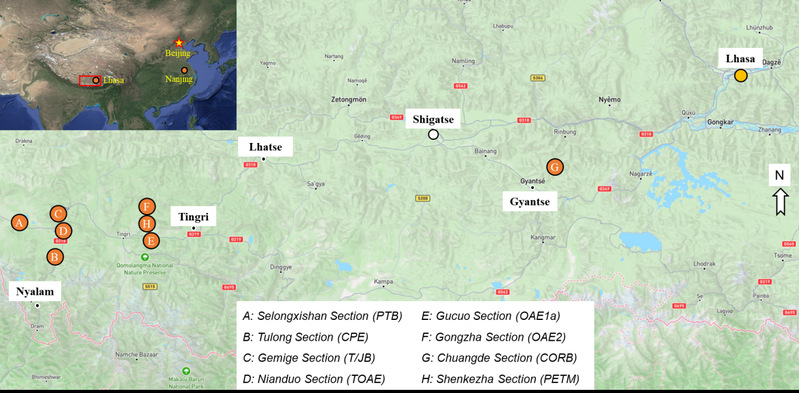
Overview of planned fieldtrip in southern Tibet, China, showing the locations of planned stops.
3. Expected topic sessions and Abstract
The presentation section will last for two days (August 17–18, 2025) during which four topical sessions on the Mesozoic–Palaeogene hyperthermal events will be organized.
S1 Long-term climatic and environmental changes in a greenhouse world
S2 Climate and Environmental changes during hyperthermal events
S3 Biotic and carbonate platform responses to hyperthermal events
S4 Carbon cycling and triggers for hyperthermal events
Please prepare abstracts using the attached template. Once ready, abstracts can be submitted via email to Dr. Jingxin JIANG
(Email:jjxcug24@163.com). The abstract deadline is May 15, 2025.
4. Registration and costs
4.1 The workshop registration fee covers the formal registration, the abstract volume, handouts, the gala dinner, coffee breaks, and lunch and dinner (including the dinner on the August 16) during the workshop. Please note that it does not include hotel costs. The fee can be paid through the website:
(https://njupay.nju.edu.cn/xysf//bmface.do?rid=7373386643553438744735513036716a3244495077673d3d&type=0).
Registration Plans-Price Table for Workshop | ||
Early Payment: Before May 15 | Late Payment: After July 01 | Onsite: August 16 |
Professional: 270 USD/2,000 CNY | Professional: 320 USD/2,300 CNY | Professional: 370 USD/2,700 CNY |
Students: 170 USD/1,200 CNY | Students: 220 USD/1,600 CNY | Students: 270 USD/2,000 CNY |
4.2 The field trip fee covers all expenses incurred during the trip, including one-way airfare from Nanjing to Tibet, all meals, accommodation, car rental, and the local Tibetan guide fee. Please note that the trip will end in Lhasa on August 26th after the field activities. Participants will need to arrange and purchase their own return flights from Tibet to Chengdu, Chongqing, Xi’an, Beijing, or Shanghai for their onward connections.
Scholars interested in participating are encouraged to confirm their attendance by emailing Dr. Jingxin JIANG (jjxcug24@163.com) by May 15 (Early bird deadline) and no later than June 30, 2025 (Final deadline).
If the total number of participants is fewer than 6, the field trip will be canceled, and all participants will be notified by July 05, 2025. Considering that refunds can be complicated and may incur bank fees resulting in significant financial loss if the field trip is canceled, participants who confirm their attendance at different times should complete payment according to the fee schedule provided in the table below by July 20, 2025.
Registration Plans-Price Table for Field Trip | |
Early Payment-before July 20 | Late Payment-After July 20 |
Professional: 1,200 USD/9,000 CNY | Professional: 1,350 USD/10,000 CNY |
5. Financial support
With funds from the IGCP739 project and Chinese grants, the organizers of the workshop will help to partially cover costs (such as travel, registration and accommodation fees) of students, female scholars, young scholars (less than 40 years old), and scholars from developing countries. We have limited grants available, with financial support of up to 1000 USD per person. If you are interested in applying for this grant, please send your research topic, a brief CV, and your submitted abstract to Dr. Jingxin JIANG (jjxcug24@163.com). The deadline for grant applications is May 15, 2025.
6. Sponsors
IUGS/UNESCO IGCP 739 Project
Natural Science Foundation of China (No. 42488201)
National Key Research and Development Project of China (No. 2023YFF0804000)
State Key Laboratory of Critical Earth Material Cycling and Mineral Deposits, Nanjing University
School of Earth Sciences and Engineering, Nanjing University
7. Scientific Committee
Members (in alphabetic order):
Santanu BANERJEE (Department of Earth Sciences, Indian Institute of Technology, India)
Jian CAO(School of Earth Sciences and Engineering, Nanjing University, P.R. China)
Xi CHEN (China University of Geosciences, Beijing, China)
Ying CUI (Department of Earth and Environmental Studies, Montclair State University, USA)
Zhongqiang Chen (School of Earth Sciences, China University of Geosciences, Wuhan, China)
Jacopo DAL CORSO (School of Earth Sciences, China University of Geosciences, Wuhan, China)
Stephen P. HESSELBO (Camborne School of Mines and Environment and Sustainability Institute, University of Exeter)
Xiumian HU (IGCP-739 Project Coordinator, School of Earth Sciences and Engineering, Nanjing University, P.R. China)
Masayuki Ikeda (Department of Earth and Planetary Science, University of Tokyo)
David KEMP (School of Earth Sciences, University of Geosciences, P. R. China)
Mingsong LI (School of Earth and Space Science, Peking University, Beijing)
Chao MA (Institute of Sedimentary Geology, Chengdu University of Technology)
Mariano N. REMÍREZ (Department of Geosciences and Natural Resource Management, University of Copenhagen)
Micha RUHL (Trinity College Dublin, The University of Dublin, Department of Geology, Dublin, Ireland)
Haijun SONG (School of Earth Science, China University of Geosciences, Wuhan)
Shijun JIANG (College of Marine Sciences and Engineering, Hainan University)
Robert J. Newton (School of Earth and Environment, University of Leeds)
İsmail Ömer YILMAZ (Department of Geological Engineering, Middle East Technical University, Türkiye)
Weiqi Yao (Department of Ocean Science and Engineering, Southern University of Science & Technology)
Xiaoqiao WAN (School of Earth Sciences and Resources, China University of Geosciences, Beijing)
Bo WANG (Nanjing Institute of Geology and Palaeontology, Chinese Academy of Sciences)
Chengshan WANG (School of Earth Sciences and Resources, China University of Geosciences, Beijing)
Yongdong WANG (Nanjing Institute of Geology and Palaeontology, Chinese Academy of Sciences)
Shiling YANG (Institute of Geology and Geophysics, Chinese Academy of Sciences, Beijing, China)
8. Organizing Committee
Xiumian HU (Chair, IGCP-739 Project Coordinator, School of Earth Sciences and Engineering, Nanjing University, China)
Xi CHEN (Institute of Earth Sciences, China University of Geosciences, Beijing)
Zhong HAN (Chengdu University of Technology, China)
Tianchen HE (College of Oceanography, Hohai University)
Jingxin JIANG (School of Earth Sciences and Engineering, Nanjing University, China)
Xin JIN (Chengdu University of Technology, China)
David KEMP (School of Earth Sciences, University of Geosciences, P. R. China)
Xianghui LI (School of Earth Sciences and Engineering, Nanjing University, China)
Yongxiang LI (School of Earth Sciences and Engineering, Nanjing University, China)
Yiwei XU (Nanjing Institute of Geology and Palaeontology, Chinese Academy of Sciences)
Shang ZHU (School of Earth Sciences and Engineering, Nanjing University, China)
9. Transport and Accommodation suggestions
a) Transportation
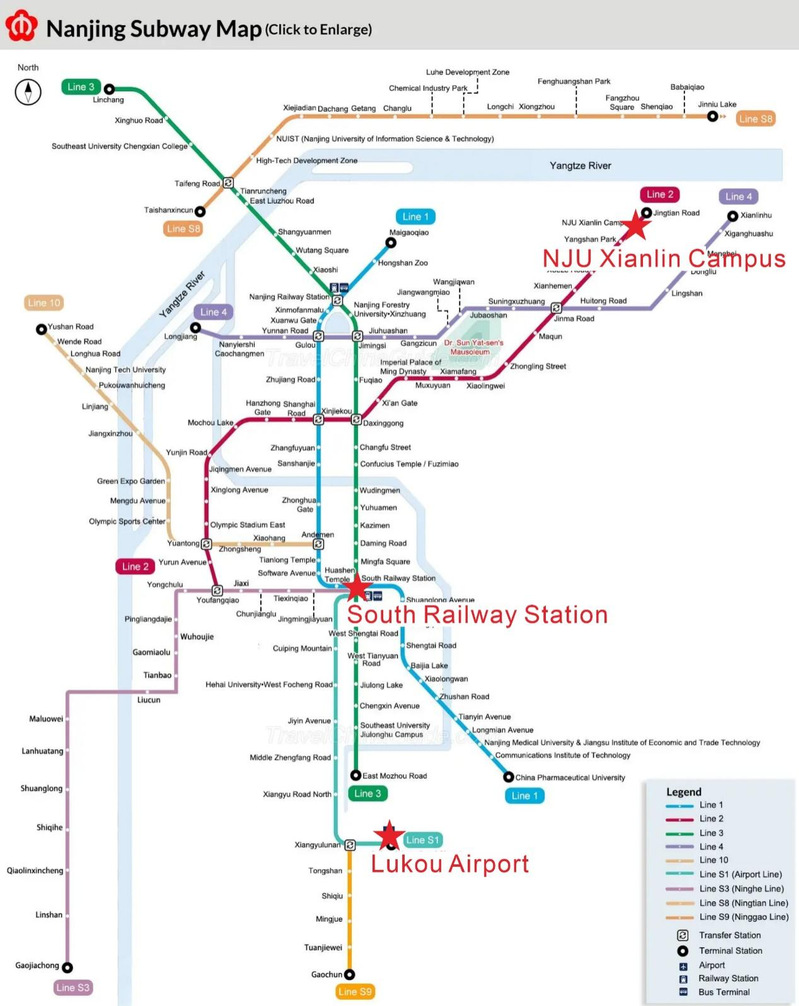
From Lukou airport, there are shuttle buses, taxis or private transfers that can be taken from the airport and bus terminal to the hotel where the conference will be held. By train, take Metro Line S1 from Lukou Airport, and transfer to Metro Line 3 at Nanjing South Railway Station, then switch to Metro Line 2 at Daxinggong Station to reach the Xianlin Campus of Nanjing University. The journey takes approximately 1 hour and 40 minutes.
b) Venue
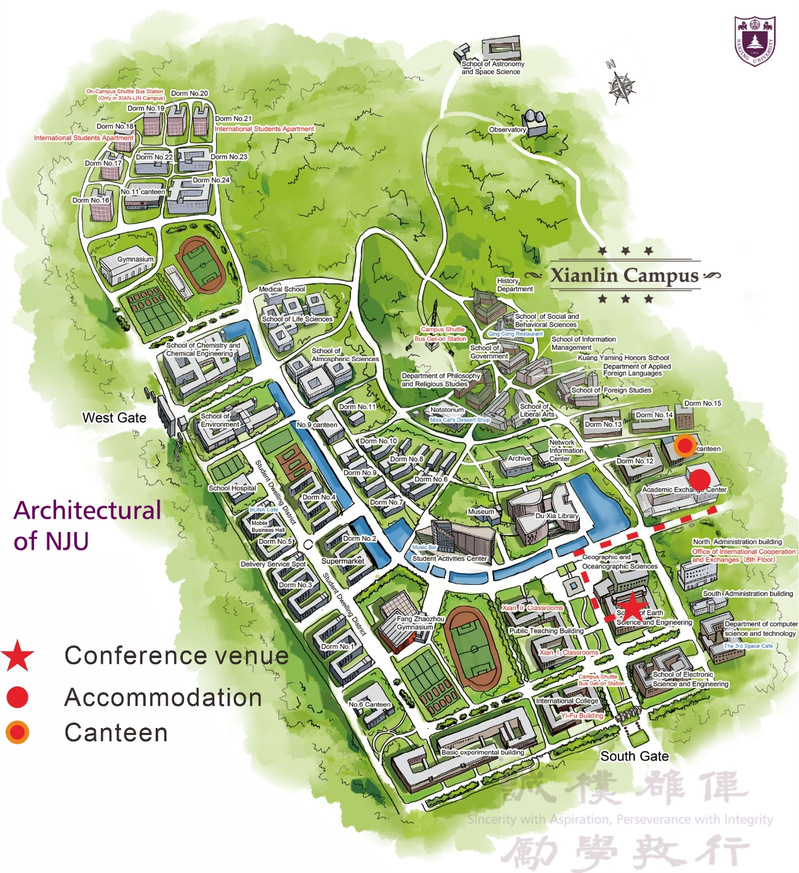
This workshop will be held in the International Conference Center, Nanjing University
c) Accommodation
Nanjing University International Conference Center
Room Price(CNY)
Deluxe Double Room 380(Includes single breakfast 98 RMB)
Deluxe King Room 380(Includes single breakfast 98 RMB)
Executive Double Room 468(Includes single breakfast 98 RMB)
Executive King Room 490(Includes single breakfast 98 RMB)
10. Contacts
For scientific information:
Dr. Jingxin Jiang (School of Earth Sciences and Engineering, Nanjing University)
Email: jjxcug24@163.com
For registration, hotel eservation, payment and others:
Dr. Shang Zhu (School of Earth Sciences and Engineering, Nanjing University)
Email: zhushang@nju.edu.cn
For more information, please visit:
Website: https://es.nju.edu.cn/igcp739/main.htm
We are looking forward to seeing you in Nanjing, China!
The organizing committee.
February 12, 2025
 International Workshop on Hyperthermals(First Circular).pdf
 Abstract Template For IGCP739.docx