
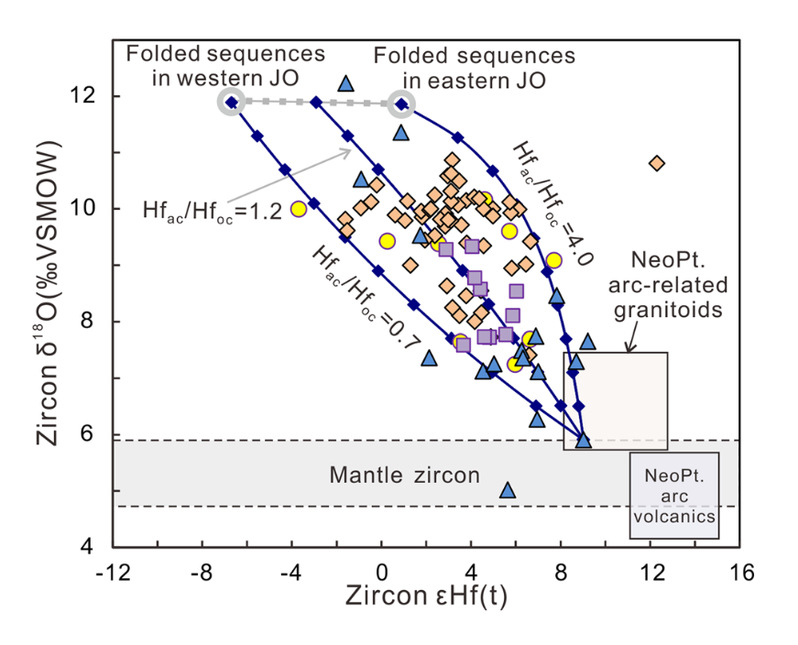
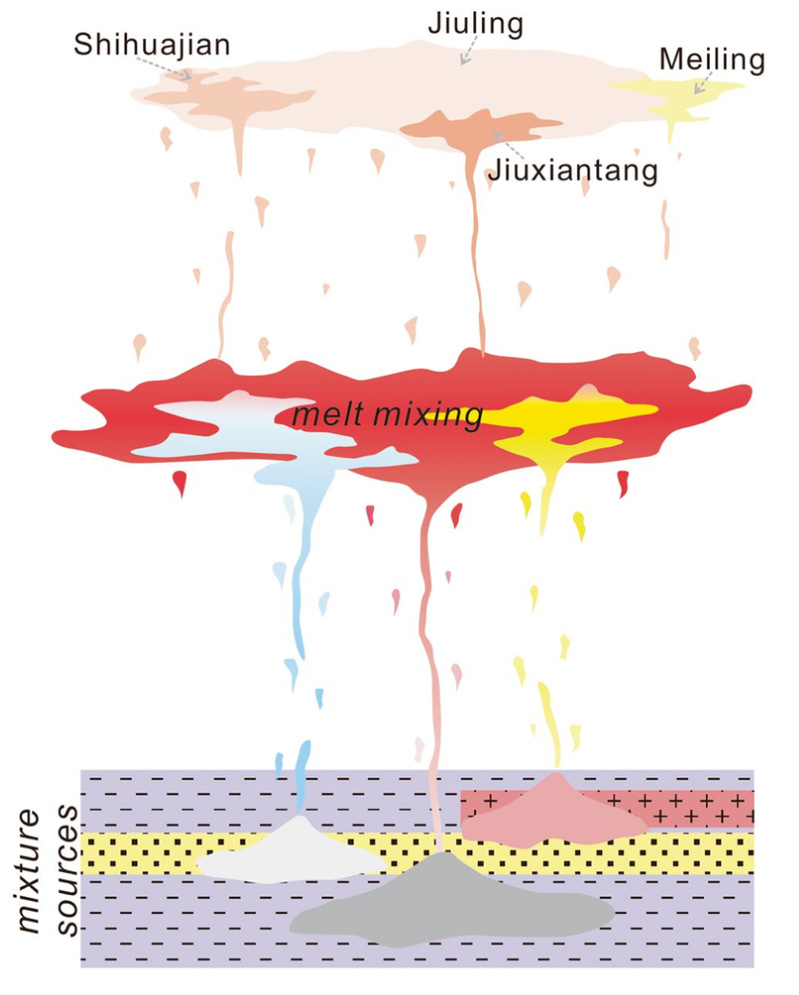
Granite batholiths record the processes that occur during the formation and diferentiation of the continental crust. The ~4000 km2 composite Neoproterozoic Jiuling batholith is one of the largest batholiths in southern China and consists of four peraluminous granitoid intrusions that were emplaced at ca. 828–810 Ma. These granitoids defne a trend that moves from the terrestrial towards the seawater Nd–Hf isotope array, indicating the source of these magmas incorporated increasing amounts of marine sedimentary material over time. Our new geochronological and geochemical data suggest that the composite Neoproterozoic Jiuling batholith formed incrementally via the intrusion of multiple batches of crustally derived melts. The intrusions within the batholith are characterized by decreasing Rb/Sr ratios and increasing Na/K ratios and εHf(t) values, suggesting variations in source composition over time. These inter-intrusion variations can be well explained by three-component mixing in magma sources (mature, immature sediments and felsic arc-related granitoids) prior to partial melting, with inter-sample variations within individual intrusions occurring as a result of the subsequent mixing of diferent melt batches. The frst stage of mixing within the source of these magmas involves a signifcant variation in source compositions and cannot refect the simple melting of a heterogeneous metasedimentary source region. The second stage of mixing occurred during magma ascent and storage, and is recorded by variations in mineral compositions (e.g., zircon). These interintrusion and inter-sample geochemical variations provide evidence that the peraluminous Jiuling batholith formed as a result of two mixing processes, namely mixing within the magma source region and mixing of multiple batches of granitic melts. This dual mixing could explain the signifcant geochemical diversity present within peraluminous granitoid rocks worldwide.
Details on https://doi.org/10.1007/s00410-020-01757-2  Wang2021-Contrib Mineral Petrol-Dual mixing for the formation of Neoproterozoic granitic intrusions within the.pdf