
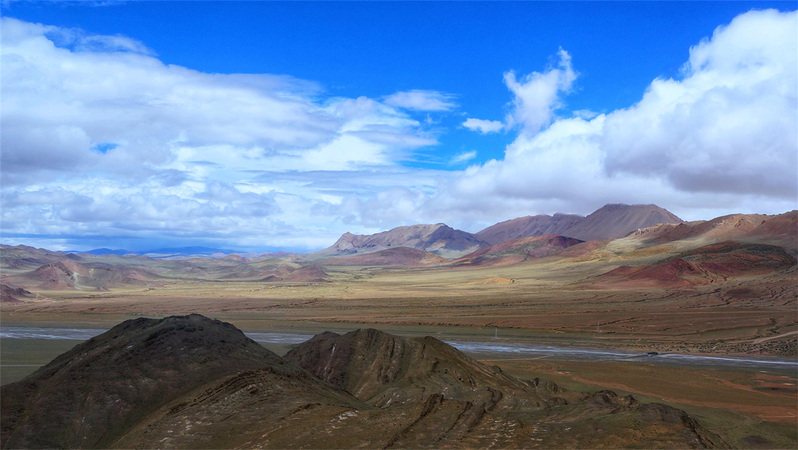
Our research largely focuses on the sedimentologic, environmental and climate change over the last 300 million years of Earth history. We are particularly interested in the short-lived extreme global warming events, known as hyperthermals, such as the Permian-Triassic boundary mass extinction event (PTB; ca. 252 Ma), the Carnian Pluvial Event (CPE, ca. 230 Ma), the Triassic-Jurassic boundary mass extinction event (ca. 201 Ma), the early Toarcian oceanic anoxic event (TOAE; ca. 182 Ma), the Cretaceous Ocean Anoxic Events (OAEs; ca. 120 Ma and 93 Ma), the Paleocene-Eocene Thermal Maximum (PETM; ca. 56 Ma) and the Early Eocene Climatic Optimum (ca. 51 to 53 Ma). What drove these climatic changes? What were the consequences? To address these questions we combine stratigraphic, sedimentological, microfossils, stable isotope and elemental compositions, to reconstruct past environmental conditions.
Main Members
PhD student:
Postgraduate student:
Former Post-Doc.:
Graduated PhD student:
Graduated from master's degree:
Publication:
Hu, X.M., Li, J., Han, Z., Li, Y.X., 2020. Two types of hyperthermal events in the Mesozoic-Cenozoic: Environmental impacts, biotic effects, and driving mechanisms. Science China Earth Sciences 63, 1041–1058.
Zhang, S.J., Hu, X.M., Han, Z., Li, J., Garzanti, E., 2018. Climatic and tectonic controls on Cretaceous-Palaeogene sea-level changes recorded in the Tarim epicontinental sea. Palaeogeography Palaeoclimatology Palaeoecology 501, 92-110.
Han, Z., Hu, X.M., Kemp, D.B., Li, J., 2018. Carbonate-platform response to the Toarcian Oceanic Anoxic Event in the southern hemisphere: Implications for climatic change and biotic platform demise. Earth and Planetary Science Letters 489, 59-71.
Hu, X.M., Wagreich, M., Sames, B., 2017. Special Topic: Cretaceous greenhouse palaeoclimate and sea-level changes. Science China-Earth Sciences 60, 1-4.
Li, J., Hu, X.M., Garzanti, E., BouDagher-Fadel, M.K., 2017. Shallow-water carbonate responses to the Paleocene-Eocene thermal maximum in the Tethyan Himalaya (southern Tibet): Tectonic and climatic implications. Palaeogeography Palaeoclimatology Palaeoecology 466, 153-165.
Han, Z., Hu, X.M., Li, J., Garzanti, E., 2016. Jurassic carbonate microfacies and relative sea-level changes in the Tethys Himalaya (southern Tibet). Palaeogeography Palaeoclimatology Palaeoecology 456, 1-20.
Li, J., Hu, X.M., Zhao, K.D., Cai, Y.F., Sun, T., 2016. Paleoceanographic evolution and chronostratigraphy of the Aptian Oceanic Anoxic Event 1a (OAE1a) to oceanic red bed 1 (ORB1) in the Gorgo a Cerbara section (central Italy). Cretaceous Research 66, 115-128.
Hu, X.M., Scott, R.W., Cai, Y.F., Wang, C.S., Melinte-Dobrinescu, M.C., 2012. Cretaceous oceanic red beds (CORBs): Different time scales and models of origin. Earth-Science Reviews 115, 217-248.
Hu, X.M., Zhao, K.D., Yilmaz, I.O., Li, Y.X., 2012. Stratigraphic transition and palaeoenvironmental changes from the Aptian oceanic anoxic event 1a (OAE1a) to the oceanic red bed 1 (ORB1) in the Yenicesihlar section, central Turkey. Cretaceous Research 38, 40-51.
Hu, X., M. Cheng, W., Ji, J., 2009, Origin of the Cretaceous Oceanic Red Beds (CORBs) as interpreted by Visible Reflectance and Inorganic Geochemistry from the Vispi Quarry Section, Central Italy, in Hu, X., Wang, C., Scott, R.W., Wagreich, M., and Jansa, L., eds., Cretaceous Oceanic Red Beds: Stratigraphy, Composition, Origins and Paleoceanographic/Paleoclimatic Significance: Tulsa, OK, SEPM Special Publication 91, p. 183-197.
Hu, X.M., Jansa, L., Wang, C.S., 2008. Upper Jurassic-Lower Cretaceous stratigraphy in south-eastern Tibet: a comparison with the western Himalayas. Cretaceous Research 29, 301-315.
Hu, X.M., Jansa, L., Sarti, M., 2006. Mid-Cretaceous oceanic red beds in the Umbria-Marche Basin, central Italy: Constraints on paleoceanography and paleoclimate. Palaeogeography Palaeoclimatology Palaeoecology 233, 163-186.
Hu, X.M., Wang, C.S., Li, X.H., Jansa, L., 2006. Upper Cretaceous oceanic red beds in southern Tibet:Lithofacies, environments and colour origin. China Science Series D Earth Sciences 49, 785-795.
胡修棉, 王成善, 李祥辉, Jansa, L., 2006. 藏南上白垩统大洋红层:岩石类型、沉积环境与颜色成因. 中国科学:地球科学, 36, 811-821
Hu, X.M., Jansa, L., Wang, C. S., Sarti, M., Bak, K., Wagreich, M., Michalik, J., Sotak, J., 2005. Upper Cretaceous oceanic red beds (CORBs) in the Tethys: occurrences, lithofacies, age, and environments. Cretaceous Research 26, 3-20.