 |
|
翁辉辉
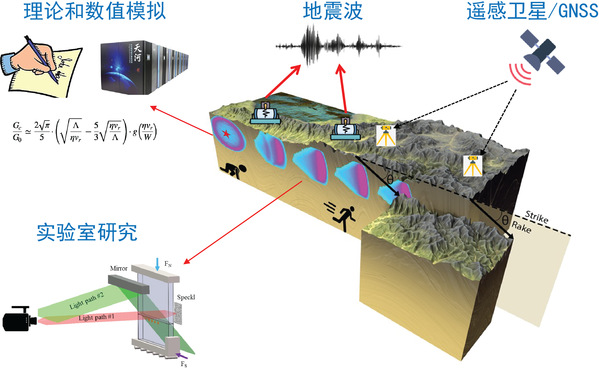
个人简介翁辉辉博士,副教授(PI,特聘研究员),博士生导师,主要从事震源物理的理论和数值模拟研究,入选2021年国家青年人才(海外)计划。2015年取得中国科学技术大学博士学位,先后在香港中文大学、法国UCA和法国国家科学研究中心从事博士后工作,2022年9月加入南京大学。研究兴趣包括但不限于:震源物理的理论和数值模拟研究、估算油田诱发地震的最大震级、大地震动态破裂过程反演等,在Nature Geoscience, Nature Communications, JGR, GRL等国内外刊物发表论文十余篇。 研究方向 • 地震破裂理论 • 数值模拟 • 断裂带变形机制 • 评估大地震震级
教学情况 自2025 深部构造与地球动力学(联合授课) 自2022 地震学(独立授课) 2019 International summer schools 海报 2019 Advanced Workshop on Earthquake Fault Mechanics: Theory, Simulation and Observations at ICTP. Trieste, Italy 科研情况 在研项目: 1、国家自然科学基金委-优秀青年(海外)科学基金,主持,在研 2、国家自然科学基金委-面上项目,主持,在研 3、国家重点研发计划,专题负责人,在研 4、国家自然科学基金委-重大非共识项目,课题负责人,在研 学术兼职 基金评审人:国家自然科学基金(NSFC)、美国自然科学基金(NSF)、新西兰马斯登基金(Marsden fund) 期刊评审人:Nature Communications, JGR, GRL, GJI,Tectonophysics, BSSA, SRL, Terra Nova, Pure and Applied Geophysic
详情欢迎访问个人主页:https://huihuiweng.github.io/ 课题组长期招收硕士、博士研究生、博士后/专职科研岗,欢迎对地震震源物理、断层活动等感兴趣的你加入! Diving into the Unknown! 教育经历工作经历学术兼职研究方向开授课程科研项目学术成果(* corresponding author)Submitted / in preparation:[S5] Dezheng Zhao#, Huihui Weng*, Qin Wang, Yijian Zhou, Han Chen (2024). Multiscale fault-zone structures governed by earthquake rupture dynamics. Submitted. [https://doi.org/10.21203/rs.3.rs-5432823/v1] [S4] Huihui Weng*, Loes Buijze, Jean-Paul Ampuero (2024). Theoretical model for physics-based estimation of maximum earthquake sizes. Submitted. [S3] Loes Buijze, Huihui Weng, Jean-Paul Ampuero (2023). Physics-based estimates of the maximum magnitude of induced earthquakes in the Groningen gas field (application part). In manuscript. [S2] Huihui Weng*, Jean-Paul Ampuero (2023). Toward assessing seismic hazard from laboratory observations of rate-and-state frictional parameters. In manuscript. [S1] Huihui Weng*, Jean-Paul Ampuero (2023). The theoretical energy release rate of in-plane elongated ruptures. In manuscript. Published:[17] H. Weng*, The dynamics of fast and slow earthquake ruptures in viscoelastic materials” Journal of Geophysical Research: Solid Earth, 2025. [ [16] Diao, F.*, H. Weng*, J. P. Ampuero, Z. Shao, R. Wang, F. Long and X. Xiong, “Physics-based assessment of earthquake potential on the Anninghe-Zemuhe fault system in southwestern China.”Nature Communications, 2024. [ [15] D. Zhao, C. Qu, X. Shan, W. Gong, H. Weng, H. Chen, D. Wu, “An updated fault coupling model along major block-bounding faults on the eastern and northeastern Tibetan Plateau from a stress-constrained inversion of GPS and InSAR data.” Journal of Geophysical Research: Solid Earth, 2024. [https://doi.org/10.1029/2023JB028483] . Numerical modelling of earthquake cycles based on Navier-Stokes equations with Viscoelastic-plasticity rheology. G-cube,2023. [ [13] H. Weng* and J.P. Ampuero, Integrated rupture mechanics for slow slip events and earthquakes. Nature Communications, 2022. [ [12] H. Weng* and J.P. Ampuero, Continuum of earthquake rupture speeds enabled by oblique slip. Nature Geoscience, 2020. [ [11] Oral E., H. Weng, and J.P. Ampuero, Does a damaged fault zone mitigate the near-field impact of supershear earthquakes? Application to the 2018 Mw 7.5 Palu earthquake. Geophysical Research Letters, 47(1), 2020. [ [10] H. Weng* and J.P. Ampuero, The dynamics of elongated earthquake ruptures. Journal of Geophysical Research: Solid Earth, 124, 2019. [ [9] H. Yang, S. Yao, B. He, A. Newman, and H. Weng, Deriving rupture scenarios from interseismic locking distributions along the subduction megathrust. Journal of Geophysical Research: Solid Earth, 2019. [ [8] H. Weng and H. Yang, Constraining frictional properties on fault by dynamic rupture simulations and near-field observations. Journal of Geophysical Research: Solid Earth, 123(8), 6658-6670, 2018. [ [7] H. Weng and H. Yang, Seismogenic width controls aspect ratios of earthquake ruptures. Geophysical Research Letters, 44(6): 2725-2732, 2017. [ [6] H. Weng, H. Yang, Z. Zhang, and X. Chen, Earthquake rupture extents and coseismic slips promoted by damaged fault zones. Journal of Geophysical Research: Solid Earth, 121(6): 4446-4457, 2016. [ [5] J. Yin, H. Yang, H. Yao, and H. Weng, Coseismic radiation and stress drop during the 2015 Mw8.3 Illapel, Chile megathrust earthquake. Geophysical Research Letters, 43: 1520-1528, 2016. [ [4] H. Weng, J. Huang, and H. Yang, Barrier-induced supershear ruptures on a slip-weakening fault. Geophysical Research Letters, 42(12): 4824-4832, 2015. [ [3] H. Weng, and J. Huang, Numerical simulations about subduction earthquake cycles: The case of Japan Tohoku Mw9.0 earthquake. Journal of Geodesy and Geodynamics (in Chinese), 2015. [2] H. Weng, and J. Huang, Numerical simulations about the influence of stress disturbance on earthquake cycle and seismic moment. Acta Seismologica Sinica (in Chinese), 2015. [1] F. Diao, X. Xiong, R. Wang, Y. Zheng, T. R. Walter, H. Weng, and J. Li, Overlapping post-seismic deformation processes: afterslip and viscoelastic relaxation following the 2011 Mw 9.0 Tohoku (Japan) earthquake. Geophysical Journal International, 196(1): 218-229, 2014. [ 荣誉奖励风采展示 |