|
|
刘春
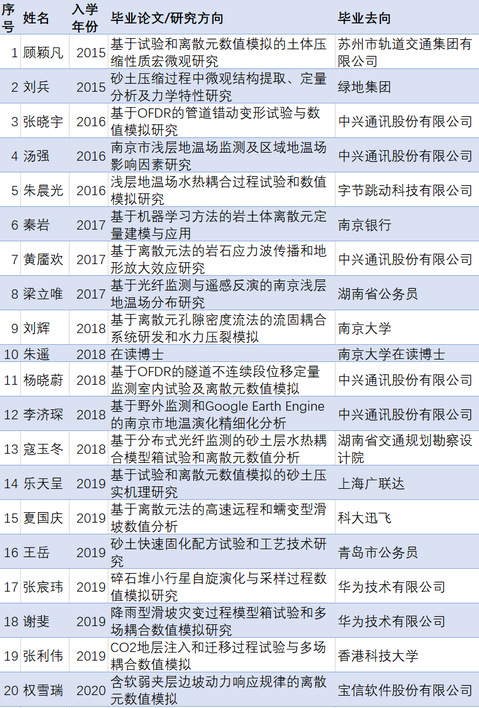
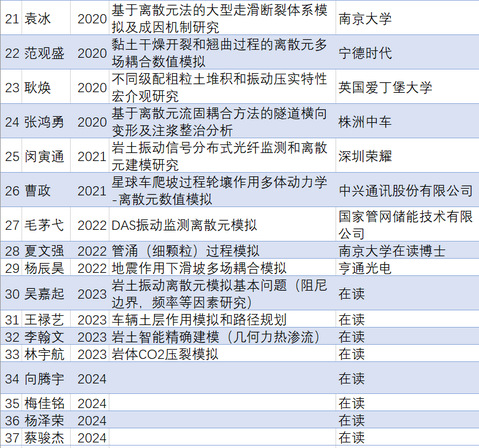
个人简介刘春,教授,博导,地质工程教研室主任,国家优青,中国岩石力学与工程学会兼职副秘书长和青委会副主任,国际岩石力学与岩石工程学会 (ISRM) 中国国家小组副主席,《岩石力学与工程学报》期刊编委等。2012年博士毕业于南京大学,后在斯坦福大学开展博士后研究。主要从事计算工程地质研究,在岩土离散元理论研究,系统研发和工程应用方面取得成果。近年来主持国家自然科学基金(5项),国家重点研发计划课题,及省部级科研项目20余项。已发表学术论文100余篇,论文SCI他引2000余次;出版中英文专著各1 部;主讲课程入选江苏首批省级一流本科课程;已申请和获得国家发明专利20余项,PCT国际专利2项,软件著作权10余项。2016年获工程地质“谷德振青年科技奖”;2017年入选中国科协“青年人才托举工程”;2019年入选江苏省六大人才高峰高层次人才,自主研发的高性能离散元软件MatDEM获“中国数字仿真自主软件创新奖”;2022年获“钱七虎奖”;2023年获江苏专利银奖(排名1),教育部自然科学奖一等奖(排名4)。 招地质工程和岩土相关方向博士后,请发送简历至chunliu@nju.edu.cn 教育经历2002.09-2006.07 南京大学地球科学系 地质工程专业 本科生 2007.09-2012.07 南京大学地球科学与工程学院 地质工程专业 硕士和博士生 2009.09-2010.10 斯坦福大学地球科学学院 地质力学 联合培养博士生 工作经历2021.12-至今 南京大学地球科学与工程学院 地质工程 教授 2014.07-2021.11 南京大学地球科学与工程学院 地质工程 副教授 2013.09-2014.09 斯坦福大学 地质力学 博士后 2012.09-2014.07 南京大学地球科学与工程学院 地质工程 助理研究员 在读和毕业生情况 (详见http://matdem.com/list/?10_1.html)
学术兼职研究方向Ø研究方向:计算工程地质 本方向涉及岩土离散元理论研究,系统研发和工程应用研究,主要包括:岩土体离散元接触模型和跨尺度建模理论;地质和工程灾害的水热力多场耦合模拟方法和技术;宏观和孔隙尺度流固耦合方法和技术;面向工程尺度分析的高性能计算方法;工程地质原创离散元仿真软件研发、耦合和协同计算;数字孪生技术、人工智能与工程地质计算的综合应用。详见网址:http://matdem.com/ 基于非连续的离散元法和自主离散元软件MatDEM,近期主要发展以下方向:(1)岩土振动和动力作用仿真;(2)星球车轮壤作用多体动力学仿真;(3)孔隙和裂隙介质污染物运移数值模拟;(4)地质灾害多场耦合数值模拟;(5)监测数据和仿真双驱动的工程事件人工智能识别。成熟的功能和案例代码均共享于软件中,支持国内外数千用户开展高性能离散元分析,软件和教程下载可见http://matdem.com 基于MatDEM数值模拟结果,2023年国内高校共有28篇学术论文发表,其中14篇为SCI论文(8篇SCI一区,3篇二区),14篇为中文论文。(友情提醒:基于MatDEM发表论文,请务必在标题、摘要或关键词中包含MatDEM,方便后续检索和引用) >联系方式:江苏省南京市栖霞区仙林大道163号, 南京大学地球科学与工程学院 >E-mail:chunliu@nju.edu.cn >离散元QQ交流群1(已满):668903775 >离散元QQ交流群2:601890478 微信公众号:
开授课程本科生:区测地质实习(大二下);Matlab地学应用(大三上) 研究生:岩土工程数值分析(硕);现代工程地质专题(硕);现代工程地质研究(博) 科研项目近三年主要研究课题: 1、国家自然科学基金优秀青年科学项目,国家自然科学基金委员会,42222707,计算工程地质,2023/01-2025/12,正在进行; 2、科技部国家重点研发计划课题,跨尺度渗漏通道地下水复合污染传输机制与风险评估,2023YFC3707902,2023/12-2027/11,正在进行; 3、国家自然科学基金面上项目,国家自然科学基金委员会,41977218,库岸土质滑坡多场关键信息量化和多场流固耦合灾变过程研究,2020/01-2023/12,已结题; 4、华为技术有限公司,分布式光纤传感振动信号建模,2022/10-2023/07,已结题; 5、特定砂土压实工艺仿真计算,2021/05-2022/05,已结题; 6、中国石化石油勘探开发研究院,塔里木盆地典型走滑断裂体系发育过程离散元数值模拟,2021/09-2022/09,已结题; 学术成果专著: 刘春. 地质与岩土工程矩阵离散元分析. 2019, 北京:科学出版社. Liu C.* Matrix Discrete Element Analysis of Geological and Geotechnical Engineering. 2021, Springer 论文: 1. Zhu, Y., Liu, C.*, Liu, H., Kou, Y., & Shi, B. A multi-field and fluid–solid coupling method for porous media based on DEM-PNM. Computers and Geotechnics, 2023, 154. doi:10.1016/j.compgeo.2022.105118 2. Zhang T., Liu C.*, Bayer P., Zhang L., Gong X.L., U K., Shi B.*. City-wide monitoring and contributing factors to shallow subsurface temperature variability in Nanjing, China. Renewable Energy, 2022 (199): 1105–1115. 3. Liu C.*, Shi B.*, Gu K., Zhang T., Tang C., Wang Y, Liu S. Negative Pore Water Pressure in Aquitard Enhances Land Subsidence: field, laboratory and numerical evidence. Water Resources research, 2022, 58(1), e2021WR030085. 4. Le T., Liu C.*, Tang C., Zhang X., Shi B. Numerical Simulation of Desiccation Cracking in Clayey Soil Using a Multifield Coupling Discrete-Element Model. Journal of Geotechnical and Geoenvironmental Engineering, 2022, 148(2): 04021183. 5. Liu C.*, Liu H., Zhang H. MatDEM-Fast Matrix Computing of the Discrete Element Method[J]. Earthquake Research Advances, 2021: 100010. 6. Qin Y., Liu C.*, Zhang X., Wang X., Shi B., Wang Y., Deng S. A three-dimensional discrete element model of triaxial tests based on a new flexible membrane boundary. Scientific Reports, 2021, 11(1): 4753. 7. Yuan B., Liu C.*, Qin Y., et al. A discrete element modeling of rock and soil material based on the machine learning[C]//IOP Conference Series: Earth and Environmental Science. IOP Publishing, 2021, 861(3): 032015. 8. Xie F., Liu C.*, Zhao T., Xia G. Slope stability analysis via Discrete Element Method and Monte Carlo Simulations[C]//IOP Conference Series: Earth and Environmental Science. IOP Publishing, 2021, 861(3): 032023. 9. Zhang L., Liu C.*, Li J. An investigation of influencing factors of land surface temperature based on the iButton and MODIS temperature data[C]//IOP Conference Series: Earth and Environmental Science. IOP Publishing, 2021, 861(3): 042054. 10. Lin Z., Wang Y., Tang C., Cheng Q., Zeng H., Liu C., Shi B., Discrete element modelling of desiccation cracking in thin clay layer under different basal boundary conditions, Computers and Geotechnics, 2021, 130, 2021 11. Xia G., Liu C.*, Xu C., et al. Dynamic Analysis of the High-Speed and Long-Runout Landslide Movement Process Based on the Discrete Element Method: A Case Study of the Shuicheng Landslide in Guizhou, China. Advances in Civil Engineering, 2021, 2021(S1):1-16. 12. Xue Y., Zhou J., Liu C., et al. Rock fragmentation induced by a TBM disc-cutter considering the effects of joints: A numerical simulation by DEM[J]. Computers and Geotechnics, 2021, 136:104230. 13. Zhang B., Gu K., Shi B., Liu C., Bayer P., Wei G., Gong X., Yang L. Actively heated fiber optics based thermal response test: A field demonstration. Renewable and Sustainable Energy Reviews, 2020, 134. 14. Huang F, Zhan W, Wang Z H , et al. Satellite identification of atmospheric-surface-subsurface urban heat islands under clear sky. Remote Sensing of Environment, 2020, 250:112039. 15. Liu Y., Zhang D., Wang G., Liu C., Zhang Y. Discrete element method-based prediction of areas prone to buried hill-controlled earth fissures. Journal of Zhejiang University-SCIENCE A, 2019, 20(10): 794-803. 16. Scaringi G., Fan X., Xu Q., Liu C., Ouyang C., Guillem D., Fan Y., Dai L. Some considerations on the use of numerical methods to simulate past landslides and possible new failures: the case of the recent Xinmo landslide (Sichuan, China). Landslides, 2018, 15(7): 1359-1375. 17. Gu K., Shi B., Liu C., Jiang H., Wu J. Investigation of land subsidence with the combination of distributed fiber optics sensing techniques and microstructure analysis of soils. Engineering Geology, 2018, 240: 34-47. 18. Liu, C., Xu, Q., Shi, B., Deng, S., Zhu, H. Mechanical properties and energy conversion of 3d close-packed lattice model for brittle rocks. Computers & Geosciences, 2017, 103: 12-20. 19. Liu, C., Shi B., Pollard D. D., and Gu K. Mechanism of formation of wiggly compaction bands in porous sandstone: 2. Numerical simulation using discrete element method. Journal of Geophysical Research: Solid Earth, 2015, 120: 8153-8168. 20. Liu, C., Pollard D. D., Aydin A., and Deng S. Mechanism of formation of wiggly compaction bands in porous sandstone: 1. Observations and conceptual model. Journal of Geophysical Research: Solid Earth, 2015, 120: 8138-8152. 21. Gu, K., Jin, F., Al-Tabbaa, A., Shi, B., Liu, C., Gao, L. Incorporation of reactive magnesia and quicklime in sustainable binders for soil stabilisation. Engineering Geology, 2015, 195: 53-62. 22. Deng, S., Cilona A., Morrow C., Mapeli C., Liu C., Lockner D., Prasad M., and Aydin A., Cross-bedding related anisotropy and its interplay with various boundary conditions in the formation and orientation of joints in an aeolian sandstone. Journal of Structural Geology, 2015, 77(8): 175–190. 23. Jiao K., Yao S., Liu C., Gao Y., Wu H., Li M., Tang Z. The characterization and quantitative analysis of nanopores in unconventional gas reservoirs utilizing FESEM–FIB and image processing: An example from the lower Silurian Longmaxi Shale, upper Yangtze region, China. International Journal of Coal Geology, 2014, 128-129: 1-11. 24. Liu C., Pollard D.D., Shi B. Analytical solutions and numerical tests of elastic and failure behaviors of close-packed lattice for brittle rocks and crystals. Journal of Geophysical Research: Solid Earth, 2013, 118: 71–82. 25. Liu C., Shi B., Shao Y., Tang C. Experimental and Numerical Investigation of Urban Heat Island Effect on Slope Stability. Bulletin of Engineering Geology and the Environment, 2013, 72(3-4): 303-310. 26. Liu C., Tang C., Shi B., Suo W. Automatic quantification of crack patterns by image processing. Computers and Geosciences, 2013, 57: 77-80. 27. Liu C., Yin H., Zhu L. TrishearCreator: a tool for the kinematic simulation and strain analysis of trishear fault-propagation folding with growth strata. Computers & Geosciences, 2012, 49: 200-206. 28. Tang C., Shi B., Cui Y., Liu C., Gu K. Desiccation cracking behaviour of polypropylene fiber reinforced clayey soil. Canadian Geotechnical Journal, 2012, 49(9): 1088-1101. 29. Shi B., Tang C., Gao L., Liu C., Wang B. Observation and analysis of the urban heat island effect on soil in Nanjing, China. Environmental Earth Sciences. Environmental Earth Sciences, 2012, 67(1): 215-229. 30. Liu C., Shi B., Zhou J., Tang C. Quantification and characterization of microporosity by image processing, geometric measurement and statistical methods: application on SEM images of clay materials. Applied Clay Science, 2011, 54(1): 97-106. 31. Liu C., Shi B., Tang C., Gao L. A numerical and field Investigation of underground temperatures under urban heat island. Building and Environment, 2011, 46(5), 1205-1210. 32. Tang C., Shi B., Gao L., Daniels J.L., Jiang H.T., Liu C. Urbanization effect on soil temperature in Nanjing, China. Energy and Buildings, 2011, 43(11): 3090–3098. 33. Tang C., Cui Y., Shi B., Tang A., Liu C. Desiccation and cracking behaviour of clay layer from slurry state under wetting-drying cycles. Geoderma, 2011, 116(1): 111-118. 34. Tang C., Shi B., Liu C., Gao L., Inyang H. Experimental investigation on the desiccation cracking behavior of soil layer during drying. Journal of Materials in Civil Engineering, 2011, 23(6): 873-878. 35. Tang C., Shi B., Liu C., Suo W. B., Gao L. Experimental characterization of shrinkage and desiccation cracking in thin clay layer. Applied Clay Science, 2011, 52(1-2): 69-77. 36. Liu C., Zhang Y., Wang, Y. Analysis of complete fold shape based on quadratic Bezier curves. Journal of Structural Geology, 2009, 31(6): 575-581. 37. Liu C., Zhang Y., Shi B. Geometric and kinematic modeling of detachment folds with growth strata based on Bezier curves. Journal of Structural Geology, 2009, 31(3): 260-269. 38. Tang C., Shi B., Liu C., Wang B. Influencing factors of geometrical structure of surface shrinkage cracks in clayey soils. Engineering Geology, 2008, 101(3-4): 204-217. 39. Zhu Y., Zhu C., Liu C., Liu H., Deng S. A Discrete Element Analysis of the Sliding Friction Heat in High-Speed and Long-Runout Landslides. Earthquake Research in China, 2020, 34(1):96-109. 40. Kou Y D , Liu C , Zhu C G , et al. Distributed optical fiber monitoring test and numerical simulation analysis of water-heat coupling process. IOP Conference Series: Earth and Environmental Science, 2020, 570(6):062050 (14pp). 41. Shao Y., Gao L., Liu C., Gao L. Experimental Study on Temperature Effect on Engineering Properties of Clayey Soils. Advanced Materials Research, 2012, 512: 1905-1918. 42. 张宸玮,刘春*,耿焕,刘辉. 碎石堆小行星自旋演化过程的离散元数值模拟, 2023,29(5), 743-755. DOI: 10.16108/j.issn1006-7493.2022022 43. 范观盛,黄靥欢,刘春,等.基于MatDEM的岩石应力波传播与衰减特性敏感性分析.高校地质学报, 2023, 29(3):479-486. 44. 寇玉冬,刘春*.基于高精度光纤测温的水热耦合试验[J].河南理工大学学报:自然科学版, 2023, 42(3):88-94. 45. 卢靖雯,王勤,刘春.花岗质岩浆侵位对围岩裂隙发育和热结构影响的数值模拟.地质学报, 2022, 96(10):3619-3638. 46. 张利伟, 刘春*, 李济琛, 寇玉冬. 浅层地温场连续监测和高精度模拟时空误差研究[J]. 高校地质学报, 2022, 28(1): 104-111. 47. 杨晓蔚,刘春,张晓宇,等.基于OFDR的不连续管道竖向错开变形定量监测.防灾减灾工程学报, 2021, 41(5):9.DOI:10.13409/j.cnki.jdpme.201905051. 48. 王岳, 刘春*, 刘晓磊, 刘辉, 李亚沙. 波浪作用下海床孔压累积过程离散元数值模拟[J]. 海洋学报, 2021, 43(11): 1-8. 49. 李济琛, 陈明珠, 汤强, 刘春*, 梁立唯, Peter Bayer. 南京市浅层地温场研究——基于分布式光纤测温技术. 中国地质, 2021, 48(3):939-947. 50. 张春新,朱鸿鹄,李豪杰, 张巍, 刘春.支护压力控制下隧道周围砂土变形破坏物质点法模拟.浙江大学学报:工学版, 2021, 55(7):10.DOI:10.3785/j.issn.1008-973X.2021.07.011. 51. 张鸿勇, 张艳杰, 刘春*, 施斌, 曹政. 基于离散元孔隙密度流法的地铁隧道收敛变形注浆整治分析. 隧道与地下工程灾害防治, 2021, 3(3): 100-110. 52. 向伏林, 杨天亮, 顾凯*, 施斌, 刘春, 刘苏平, 张诚成, 姜月华. 钻孔全断面分布式光纤监测中光缆-土体变形协调性的离散元数值模拟. 岩土力学 2021; 42(6):1743-1754. 53. 权雪瑞, 黄靥欢, 刘春*, 等. 川藏铁路线V 形深切河谷地形地震放大效应数值模拟. 现代地质, 2021, 35(1): 38-46. 54. 刘春*, 乐天呈, 施斌, 朱遥. 颗粒离散元法工程应用的三大问题探讨. 岩石力学与工程学报, 2020, 39 (6): 1142-1152. 55. 张天生, 刘春*, 李济琛, 施斌. 南京市浅层地温场监测方案和地温分布特点研究. 高校地质学报, 2020, 26(6): 656-664. 56. 朱遥,刘春*,刘辉,等.颗粒形态对砂土抗剪强度影响的试验和离散元数值模拟.工程地质学报,.2020,28(3):490-499. 57. 刘春*, 范宣梅, 朱晨光, 施斌. 三维大规模滑坡离散元建模与模拟研究——以茂县新磨村滑坡为例. 工程地质学报, 2019, 27(6): 1362-1370. 58. 桑宏伟, 张丹, 刘春*, 秦岩. 基于离散元法的能源管传热过程模拟. 防灾减灾工程学报, 2019, 39(04): 645-650. 59. 梁立唯, 刘春*, 秦岩, 朱晨光, 邓尚. 基于MatDEM的盾构滚刀破岩离散元建模与数值模拟. 隧道与地下工程灾害防治, 2019, 1(3): 116-122. 60. 黄靥欢, 刘春*, 张晓宇, 秦岩, 邓尚. 加载速率对岩石单轴压缩试验影响的数值模拟研究. 高校地质学报, 2019(3):423-430. 61. 朱晨光, 刘春*, 许强, 胡伟, 张晓宇. 滑坡滑带摩擦热离散元数值模拟研究. 工程地质学报, 2019, 27(3): 651-658. 62. 刘春*, 许强, 施斌, 顾颖凡. 岩石颗粒与孔隙系统数字图像识别方法及应用. 岩土工程学报, 2018, 40(5): 925-931. 63. 乐天呈, 顾颖凡, 刘春*, 秦岩. 级配与颗粒形态对砂土压缩性影响的试验和离散元数值模拟. 工程地质学报, 2018, 26(s1):539-546. 64. 秦岩, 刘春*, 张晓宇, 邓尚. 基于MatDEM的砂土侧限压缩试验离散元模拟研究.地质力学学报, 2018, 24(5):676-681. 65. 朱晨光, 刘春*, 施斌, 汤强. 边坡稳定性温度效应数值模拟研究. 高校地质学报, 2018, 24(1): 122-127. 66. 顾颖凡, 刘春*, 施斌, 吴静红, 周春慧. 苏州地面沉降区土层微观结构和宏观力学性质分析. 防灾减灾工程学报, 2018(1): 81-86. 67. 尹建华, 顾凯, 姜洪涛, 刘春*, 施斌, 刘兵. 砂土高压蠕变微观机理分析. 高校地质学报, 2018, 24(1):116-121. 68. 刘春*, 秦岩, 汤强, 乐天呈. 基于离散元法的多孔砂岩压密破坏过程数值模拟. 桂林理工大学学报. 2017, 37(03):536-540. 69. 刘春, 张晓宇, 许强, 朱晨光, 汤强. 三维离散元模型的滑坡能量守恒模拟研究. 地下空间与工程学报, 2017(s2):698-704. 70. 刘春*, 施斌, 吴静红, 汪义龙, 姜洪涛. 排灌水条件下砂黏土层变形响应模型箱试验. 岩土工程学报, 2017, 39(9):1746-1752 71. 李长圣, 尹宏伟, 刘春, 蔡申阳. 共享内存式并行离散元程序的设计与测试. 南京大学学报(自然科学), 2017, 53(6):1161-1170. 72. 汤强, 刘春*, 顾颖凡, 施斌. 土体SEM图像微观结构的识别和统计方法. 桂林理工大学学报, 2017, 37(3):547-552. 73. 索文斌, 刘春*, 施斌, 张晓宇. 深基坑PCMW工法开挖过程离散元数值模拟分析. 工程地质学报, 2017(4):920-925. 74. 张晓宇, 许强, 刘春*, 施斌. 黏性土失水开裂多场耦合离散元数值模拟. 工程地质学报, 2017, 25(6):1430-1437. 75. 刘兵, 卢毅, 刘春*, 顾凯, 舒荣军. 砂土压缩过程中微观结构提取技术研究. 工程地质学报, 2017(4):968-974. 76. 顾颖凡, 卢毅, 刘兵, 刘春*. 基于离散元法的水力压裂数值模拟. 高校地质学报, 2016, 22(1):194-199. 77. 刘春*, 施斌, 顾凯, 孙义杰. 岩土体大型三维离散元模拟系统的研发与应用. 工程地质学报, 2014, 22:551-557. 78. 吴静红, 周春慧, 姜洪涛, 苏晶文, 姜月华, 刘春, 施斌. 苏州第四纪沉积物物理性质与地面沉降生命过程分析. 岩土工程学报, 2014, 36(9):1745-1753. 79. 唐朝生, 王德银, 施斌, 刘春. 土体干缩裂隙网络定量分析. 岩土工程学报, 2013, 35(12): 2298-2305. 80. 唐朝生, 施斌, 刘春. 膨胀土收缩开裂特性研究. 工程地质学报, 2012, 20(5):663-673. 81. 施斌, 唐朝生, 高磊, 姜洪涛, 刘春. 城市和郊区浅部地温场差异. 工程地质学报, 2012, 20(1):58-65. 82. 邵玉娴, 施斌, 刘春, 顾凯, 唐朝生. 黏性土水理性质温度效应研究. 岩土工程学报, 2011, 33(10):1576-1582. 83. 唐朝生, 施斌, 高磊, 刘春, 赵理政. 城郊土体剖面含水量监测与对比研究. 工程地质学报, 2011, 19(5):656-663. 84. 唐朝生, 施斌, 高磊, 顾凯, 刘春. 土体剖面温度物理模型试验研究. 工程地质学报, 2010, 18(6):913-919. 85. 施斌, 邵玉娴, 刘春, 王宝军. 城市热岛效应对土体工程性质的影响及其关键科学问题. 工程地质学报, 2009, 17(2):180-187. 86. 刘春, 王宝军, 施斌, 唐朝生. 基于数字图像识别的岩土体裂隙形态参数分析方法. 岩土工程学报, 2008, 30(9):1383-1388. 87. 施斌, 刘春, 王宝军, 赵理政. 城市热岛效应对土的工程性质影响及灾害效应分析.地球科学进展, 2008, 23(11):1167-1173. 88. 唐朝生, 施斌, 刘春, 王宝军. 影响黏性土表面干缩裂缝结构形态的因素及定量分析.水利学报, 2007, 38(10):1186-1193. 89. 唐朝生, 施斌, 刘春, 王宝军, 高玮. 黏性土在不同温度下干缩裂缝的发展规律及形态学定量分析. 岩土工程学报, 2007, 29(5):743-749. 90. Shi B., Zhang D., Zhu H.H., Liu C. Application of distributed optical fiber strain measurement into geotechnical engineering monitoring. 8th International Workshop on Structural Health Monitoring 2011, Stanford University. (conference) 91. Shi B., Liu C., Tang C.S., Wang B.J. Urban heat island effect on engineering properties of soil and the related disaster effect. In proceeding of International symposium on drought and constructions, Paris, 2008, Sep.1-3. (conference) 荣誉奖励风采展示 |