
Soil curling is a widespread natural phenomenon found on the Earth’s surface, often occurring after desiccation cracking.Its appearance marks the weakening of soil hydro-mechanical characteristics and the deterioration of soil structure. This degradation holds the potential to give rise to a variety of geotechnical and geological engineering complications. It is essential to consider climatic factors on desiccation curling of clayey soils, particularly temperature and relative humidity, as they can significantly influence soil properties. Investigating the dependence of soil curling on temperature and relative humidity is crucial for gaining a thorough comprehension of how soil responds to climatic variables.
This study aimed to investigate the desiccation curling behavior of remolded mud samples under varying environmental conditions. A series of desiccation curling tests were performed at different temperatures (20°C, 30°C, and 40°C) and relative humidity levels (30% and 45%). The drying curling process is divided into five stages: vertical settlement stage, lateral contraction stage, concave-up curling stage, curling recovery stage and convex-up curling stage.By monitoring the change of soil water content during the curling process, the coupled effects of temperature and relative humidity on desiccation curling of a clayey soil was revealed. The evaporation rate of the soil samples increase with increasing temperature and decreasing relative humidity, and the resulting increase in the longitudinal water content gradient of soil samples accelerates the development of soil curling. The soil curling will appear at higher water content. Because of temperature softening effects, the soil will show more drastic curling changes at high temperatures.
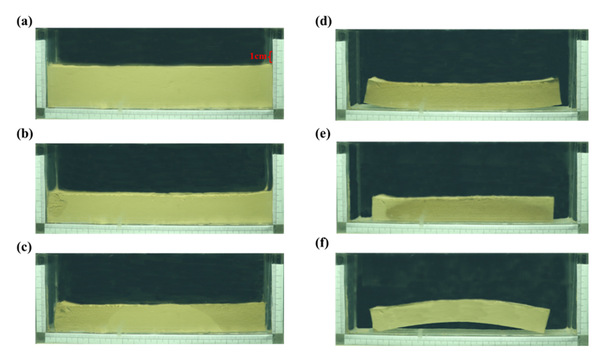
Figure 1. The soil curling process of a sample
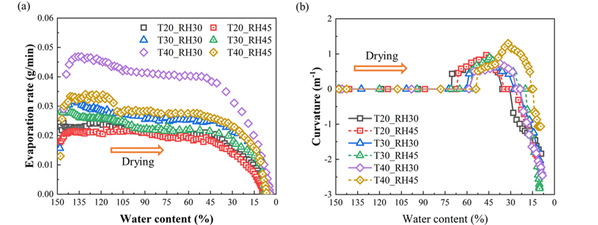
Figure 2. Coupled effects of temperature and relative humidity on soil (a) evaporations and (b) curling processes
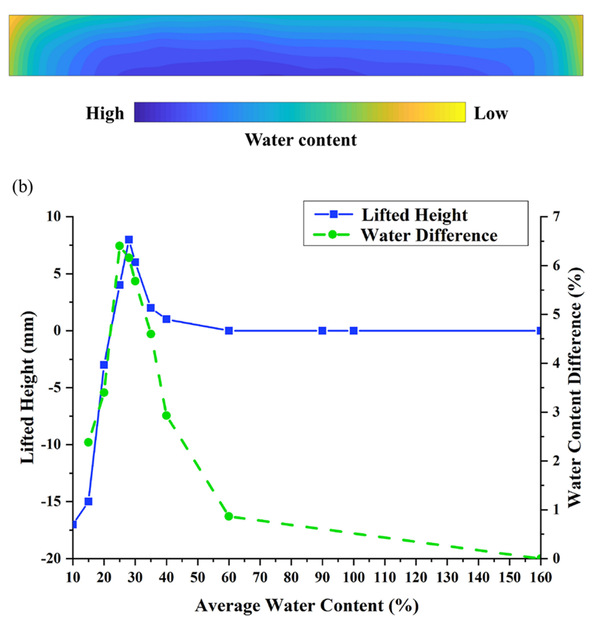
Figure 3. (a) Schematic diagram of water content gradient in samples and (b) the change of sample lifted height and water content difference with average water content
This study elucidates the soil curling characteristics under different temperature and relative humidity conditions, provides new insights into the deformation response of soils under extreme climatic events. This study was accepted by《Engineering Geology》(Title: Coupled effects of temperature and relative humidity on desiccation curling of a clayey soil). Zhan-Ming Yang (PhD student) is the first author of the paper, Professor Chao-Sheng Tang and Associate Professor Qing Cheng are the corresponding authors. The work was supported by the National Natural Science Foundation of China, National Key Research and Development Program of China and the Key Laboratory Cooperation Special Project of Western Cross Team of Western Light.