
Under arid climatic conditions, soil desiccation cracking represents a widespread natural phenomenon. The development of desiccation cracks severely compromises soil structural integrity and significantly deteriorates its engineering mechanical properties, consequently inducing various engineering geological and environmental geological issues including slope instability and foundation settlement (Fig. 1). While extensive experimental and field observations have confirmed that surface defects (such as sand particles, air bubbles and micro-pits) frequently serve as preferential locations for crack initiation, the micromechanical mechanisms through which these defects trigger cracking remain poorly understood due to the limitations of conventional experimental methods in capturing real-time evolution of internal stress fields during desiccation.
To address this scientific challenge, Professor Chao-Sheng Tang's research team innovatively employed the Discrete Element Method (DEM) to establish a numerical model coupling desiccation deformation with surface evaporation (Fig. 2). Through systematic simulation of drying processes in soil samples containing defects of varying sizes, quantities and distributions, the research has for the first time quantitatively revealed the critical role of surface defects in desiccation crack formation and development. The findings demonstrate that defect points induce significant principal tensile stress concentration within approximately 2-2.5 times their diameter range, initially forming curved microcracks that ultimately develop into characteristic "Y-shaped" cracks (Fig. 3). When existing cracks enter this influence zone, their propagation paths deflect and progressively converge toward the defect point, exhibiting a distinct "crack attraction" effect (Fig. 4). Furthermore, surface defects disrupt the hierarchical development pattern of cracks in homogeneous soils, resulting in crack networks exhibiting coexisting orthogonal and non-orthogonal morphological characteristics. This research provides the first quantitative demonstration of surface defects' dominant control over soil stress fields and cracking patterns, elucidating how structural heterogeneity modifies crack morphology and evolutionary pathways. These insights not only advance fundamental theories of soil desiccation cracking but also provide crucial scientific support for designing fracture-sensitive engineering structures such as slope reinforcement systems and landfill cover layers.
The research, entitled "Process and Mechanism of Soil Desiccation Cracking Triggered by Surface Defects Based on DEM Modeling," has been published in the authoritative geoscience journal 《Journal of Geophysical Research: Earth Surface》. The paper's first author is Dr. Tao Wang, a postdoctoral fellow at Nanjing University, and the corresponding author is Professor Chao-Sheng Tang. This work was jointly supported by the National Natural Science Foundation of China and the Natural Science Foundation of Jiangsu Province.
Paper information:
Wang, T., Tang, C.‐S., Liu, W.‐J., Cheng, Q., & Zeng, Z.‐X. (2025). Process and mechanism of soil desiccation cracking triggered by surface defects based on DEM modeling. Journal of Geophysical Research: Earth Surface, 130, e2024JF008121. https://doi.org/10.1029/2024JF008121

Fig. 1 Diagram illustration of geological and environmental hazards caused by soil desiccation cracking
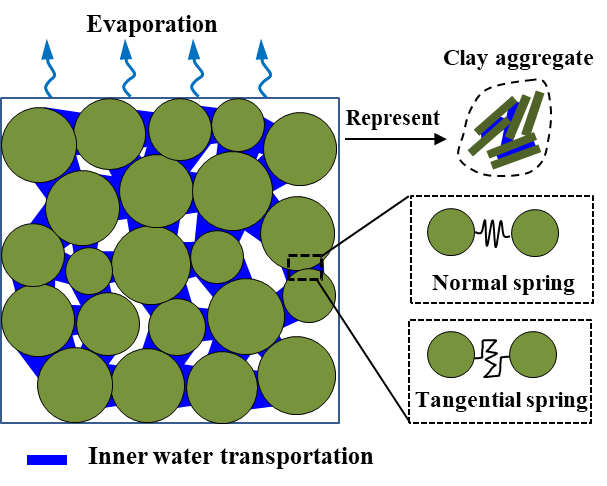
Fig. 2 Schematic diagram of DEM modeling of soil desiccation cracking

Fig. 3 Development of micro‐cracks and distribution of grain displacement and contact forces

Fig. 4 Dominant control of defect points on stress field and cracking pattern: (a) Influence on principal tensile stress field; (b) Crack attraction effect