
Soil desiccation cracking is a highly prevalent geophysical phenomenon induced by arid climatic conditions. The crack networks generated by soil shrinkage due to water loss significantly compromise soil structural integrity and mechanical strength, leading to a series of engineering geological and environmental issues such as slope instability, reduced foundation bearing capacity, soil degradation, and landfill pollutant leakage. Understanding the developmental patterns and evolutionary characteristics of soil desiccation crack networks is of great practical significance for engineering geological hazard mitigation and ecological environmental protection. However, due to the lack of a comprehensive soil constitutive model, traditional numerical simulation methods have struggled to accurately reproduce the complex morphology of real crack networks.
To address this challenge, the research team led by Professor Chao-Sheng Tang has innovatively proposed a stochastic crack generation model based on geometric parameters, supported by extensive dynamic observations and statistical analyses of soil desiccation crack networks (Fig. 1). The team successfully developed the Desiccation Crack Simulation Program (DCSP) (Fig. 2), which employs a five-step simulation mechanism: crack initiation point selection, stochastic path propagation, dynamic intersection determination, secondary crack derivation, and crack network optimization. This approach achieves dynamic simulation of the complete soil desiccation cracking progress, from initiation to propagation, intersection, and widening (Fig. 3). The proposed crack attraction effect algorithm and crack width attenuation model significantly enhance the agreement between simulation results and real soil crack network morphologies.A major innovation of this model lies in its unique predictive capability: based on partially developed crack network images, it can accurately predict subsequent crack propagation process and the final crack network morphology. Empirical studies on Xiashu soil and Pukou expansive soil demonstrate that the model's predictions exhibit high consistency with actual crack networks, with prediction accuracy improving as crack development progresses (Fig. 4). The geometric model proposed in this study provides an efficient tool for generating stochastic crack networks in cracked soil simulations. More significantly, its reliable predictive capability offers crucial theoretical underpinnings and technical support for: (1) investigating the engineering properties of desiccated soils under extreme drought conditions, and (2) developing effective prevention and mitigation strategies against desiccation cracking-induced hazards.
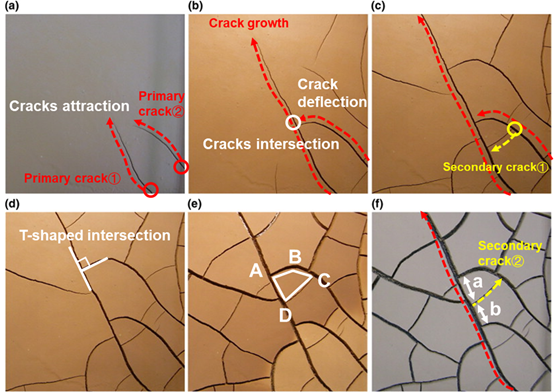
Figure 1. Dynamic development of typical soil desiccation crack networks
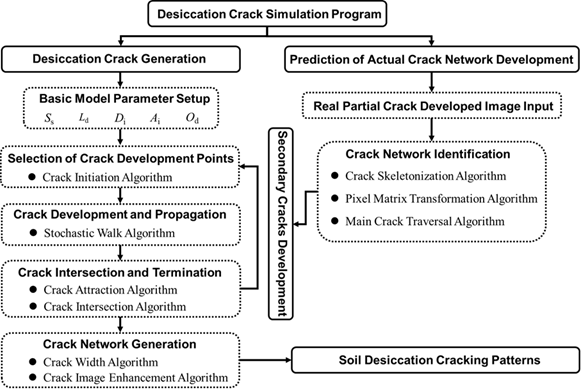
Figure 2. Flowchart of the desiccation crack simulation program
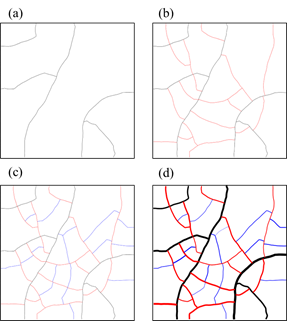
Figure 3. Stochastic simulation of soil desiccation crack networks based on DCSP
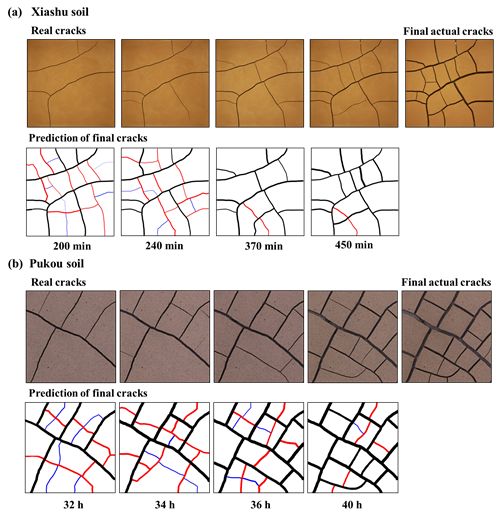
Figure 4. Prediction of soil desiccation crack network morphology based on DCSP
The research, titled Generating and predicting soil desiccation cracking patterns utilizing a stochastic model based on geometric parameters, was recently published in the leading journal Engineering Geology. PhD candidate Zhan-Ming Yang is the first author of the paper, and Professor Chao-Sheng Tang is the corresponding author. This work was supported by the National Natural Science Foundation of China, the National Key Research and Development Program of China, and the Key task project for joint research and development of the Yangtze River Delta Science and Technology Innovation Community.
Paper information:
Zhan-Ming Yang, Chao-Sheng Tang*, Tao Wang, Qing Cheng, Jun-Dong Liu, Zhi-Xiong Zeng, Zhengtao Shen. Generating and predicting soil desiccation cracking patterns utilizing a stochastic model based on geometric parameters. Engineering Geology, 2025, 353, 108122. https://doi.org/10.1016/j.enggeo.2025.108122