
Rock mass instability is a prevalent geological disaster that occurs in various human activities, including production processes, engineering construction, and natural events. The widespread nature and high frequency of such occurrences underscore the urgent need for effective prevention and control measures. It is widely acknowledged within academic and engineering communities that fractures are a primary controlling factor influencing rock mass stability. Consequently, addressing small aperture fractures to prevent their further propagation has been identified as an effective and economical strategy for proactively preventing and managing rock mass instability disasters (Fig. 1).
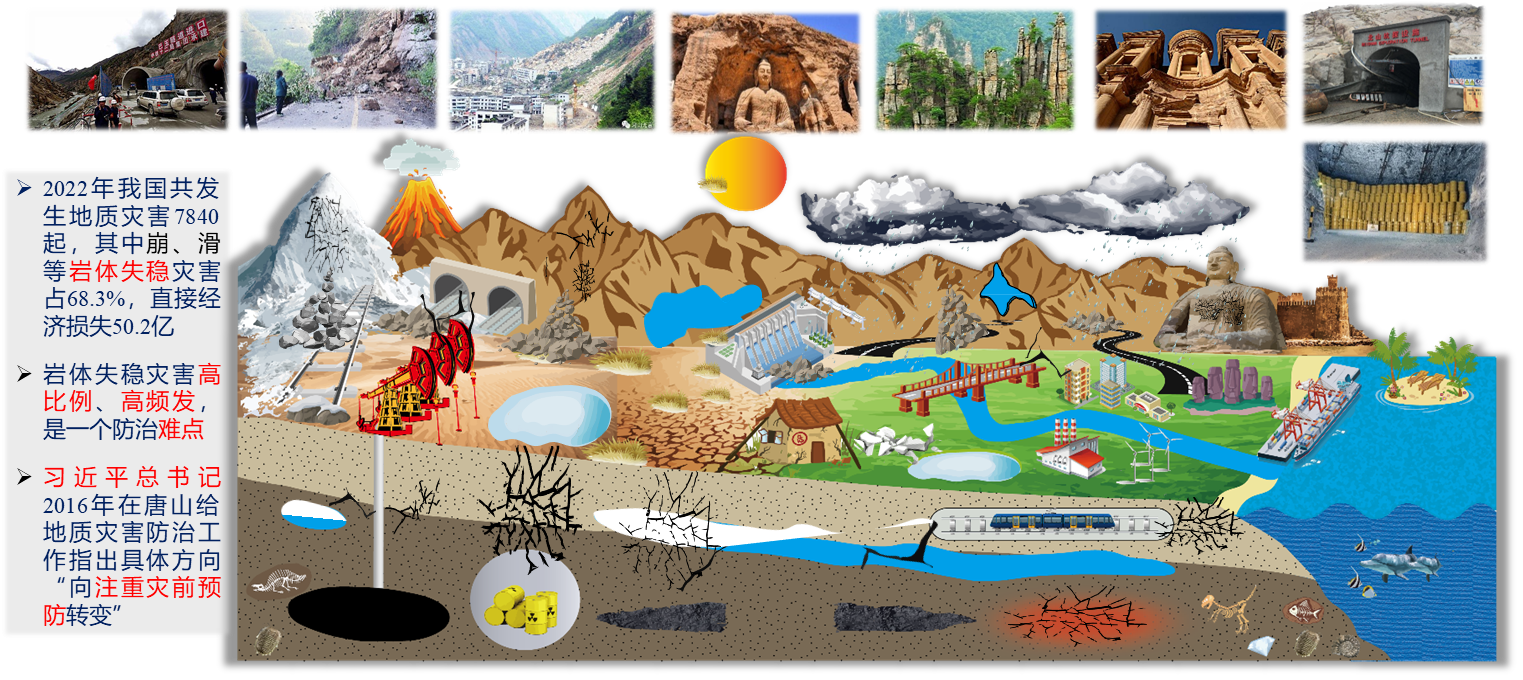
Fig. 1. Schematic Diagram of Major Types of Rock Mass Instability Disasters
Therefore, the team led by Associate Professor Pan Xiao-Hua has identified Microbial Induced Calcium Carbonate Precipitation (MICP) technology as a pivotal breakthrough. They proposed a high bridging rate healing method TS-MICP, based on a “Three-stage” injection strategy. This approach aims to enhance the durability of rock mass instability disaster prevention. Achieving uniform distribution of calcium carbonate and a high bridging rate is essential to ensure the healing material possesses excellent physical and mechanical properties, thereby preventing further deterioration and cracking of the healed fractures.
The key to effectively healing long fractures with a high bridging rate using TS-MICP lies in implementing a "Three-stage" injection strategy, which includes the gravity precipitation stage, concentrated bacteria stage, and reinforcement stage. This approach leverages the advantages inherent to each phase: (1) During the gravity precipitation stage, flocculent calcium carbonate within the mixed solution of bacterial suspension and cementation solution is rapidly and uniformly deposited at the bottom of the fracture. This process utilizes hydrogen bond flocculation and gravitational forces associated with organic matter to create an interbedded mixture of calcium carbonate and organic material. Following multiple cycles of treatment during subsequent gravity precipitation steps, along with further processing in both the concentrated bacteria step and reinforcement step, dense calcium carbonate cement characterized by a high bridging rate and strength is formed at the base. Concurrently, due to bacterial adsorption on both sides of the fracture wall, specifically in its middle and top parts, a “step” formation occurs where calcium carbonate precipitates are established. These steps serve as deposition sites for calcium carbonate during the second phase (i.e., concentrated bacteria stage), ensuring that carbonates are more evenly distributed throughout these areas (Fig. 2a). (2) In the concentrated bacteria stage, upon interaction between concentrated bacterial suspension and cementation solution, flocculent calcium carbonate can be generated more rapidly. The interception effect provided by these steps facilitates an even distribution of this flocculent calcium carbonate across both middle and top parts of the fracture (Fig. 2b). (3) Finally, in the reinforcement stage, MICP mineralization and cementation processes occur within intergranular spaces present in macroporous sediments formed during both gravity precipitation stages as well as concentrated bacteria stages until most pores are filled. This progression significantly enhances both bridging rates and bonding strength (Fig. 2C).
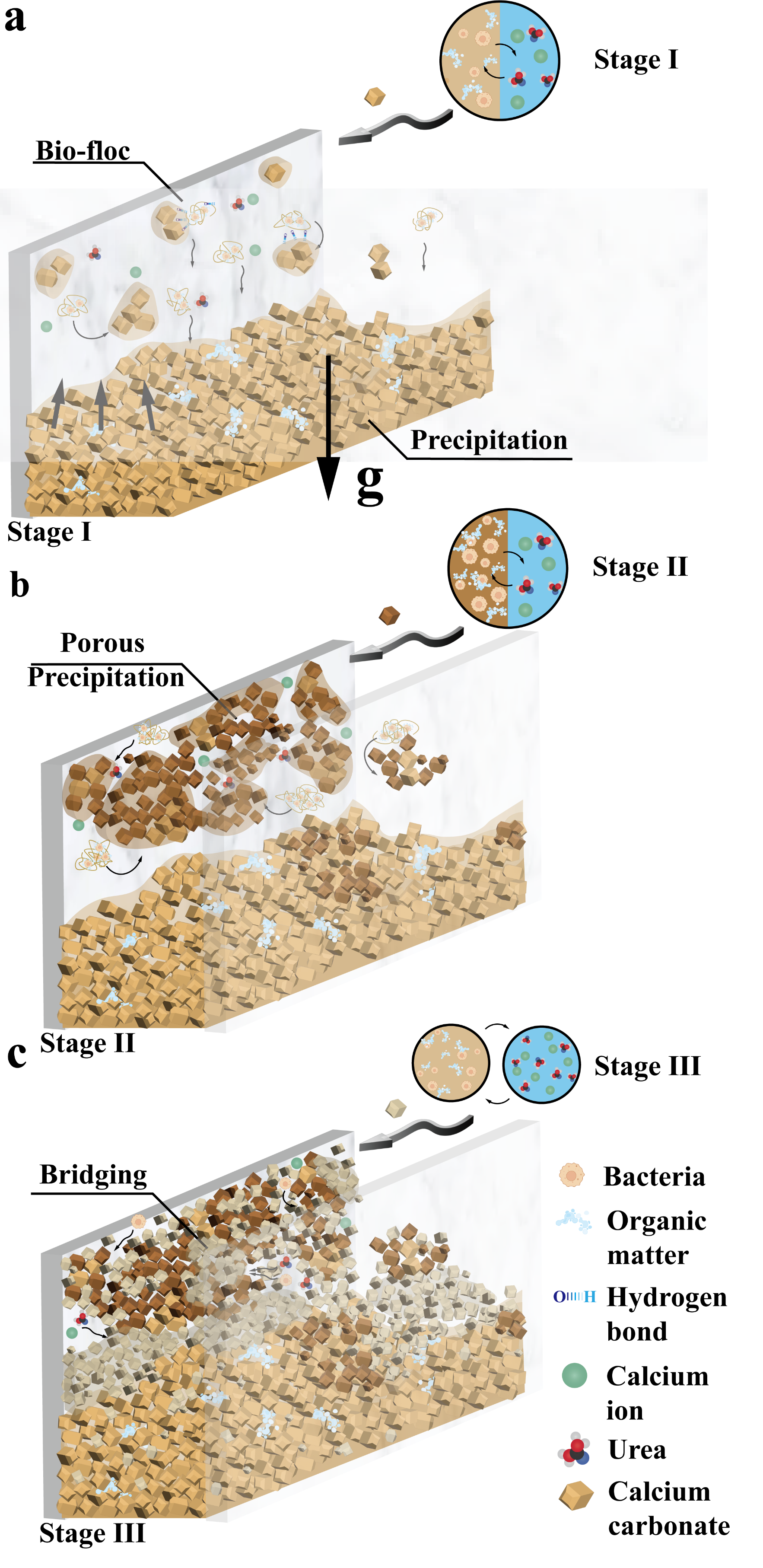
Fig. 2. Schematic diagram of the TS-MICP high bridge connection rate repair method for rock fractures: (a) gravity sedimentation stage; (b) concentrated bacteria stage; (c) reinforcement stage
Finally, the bridging rate was enhanced by a factor of 2.8 (from 32.1% to 89.5%, as shown in Fig. 2). The mechanical bonding performance exhibited an improvement of 7.4 times (ranging from 0.138 MPa to 1.023 MPa). Additionally, uniformity increased by 334.4%, and the material utilization rate improved by a factor of 1.72.

Fig. 3. Precipitation elevation and bridging area (indicated by the gray diagonal striped region) of meter-scale rock fracture model: (a) traditional two-phase injection strategy; (b) TS-MICP injection strategy
The aforementioned research findings were recently published in the Journal of Rock Mechanics and Geotechnical Engineering under the title “A Bio-Healing Method for Underground Long Rock Fractures with High Bridging Rate.” The innovative nature of this work has received high praise from both the editor-in-chief of the journal and peer reviewers. Dai Qi-Chen, a graduate student at our center, is the first author of this paper, while Associate Professor Pan Xiao-Hua serves as the corresponding author. This research was jointly funded by the National Natural Science Foundation of China and the National Key R&D Program.
Article information: Dai, Q. C., Pan, X. H*., Tang, C. S., & Shi, B. (2025). A bio-healing method for underground long rock fractures with high bridging rate. Journal of Rock Mechanics and Geotechnical Engineering. DOI: https://doi.org/10.1016/j.jrmge.2025.03.021