
The presence of cracks significantly degrades the mechanical and hydraulic properties of the soil, thereby posing a threat to the stability of earth-works like dams, slopes, channels, river banks, highway and railway embankments (Fig. 1).Tensile strength is a crucial mechanical property that governs the initiation and propagation of soil tensile cracks. Therefore, it is necessary to investigate the tensile behavior of soil and improve the existing understanding of the governing mechanisms responsible for tension-induced soil cracking. Recently, with the global prevalence of warming effects and extreme climatic events, the recurrent freeze-thaw (F-T) cycles intensify the complex evolutions of soil pore structure and tensile strength in regions with widespread seasonal freezing or permafrost active layers.However, there is limited research on the evolution of deformation and tensile strength of soils during F-T cycles, accompanied by dynamic changes in moisture. Generally, theirreversible expansion induced by F-T promotes a reduction in interparticle contacts and a weakening of cohesion and soil-water interactions, resulting indecreased tensile strength.However, desiccation-induced shrinkage facilitates interparticle contact and enhances cohesion and soil-water interactions, further increasing soil tensile strength.Hence, a pertinent issue arises: under the coupled effects of F-T cycles and desiccation processes, how will soil deformation and tensile strength respond?

Fig. 1 Schematic diagram of the soil cracking induced by the dry-wet-freeze-thaw processes and the associated slope damage.
To address the aforementioned scientific issue, Professor Tang's team conducted cyclic F-T tests on specimens with varying compaction water contents and dry densities. Subsequently, the tensile strength, void ratio, and suction along the desiccation path of the specimens were measured (Fig. 2).Experimental results reveal thatas the number of F-T cycles increases, the tensile strength shows a pattern of initially decreasing and subsequently rising, with the inflection point typically around 1.5%-2.0% lower than the compaction water content.This is mainly attributed to that in the early stages of F-T cycles, the detrimental effects of F-T dominate, leading to increased void ratio and decreased suction and tensile strength. However, in the later stages of F-T cycles, the positive effects of desiccation-induced shrinkage, increased cohesion, and suction outweigh the negative effects of F-T, resulting in an increment in tensile strength. Specimens with larger compaction water content exhibit a higher expansion and shrinkage potential.Under a few F-T cycles, soils compacted at the optimum water content and on the wet side show higher void ratio and lower suction and tensile strength compared with dry-side compacted soils. However, this trend reverses as the F-T cycles progress further. In addition, tensile strength increases as compaction dry density rises within all water content ranges,a trend unaffected by F-T cycles and desiccation process.This study elucidates the evolution mechanism of soil tensile strength under the coupled effects of F-T cycles and desiccation processes from the perspective of the microstructure characterized by aggregates, interaggregate pores, and water-bridges (Fig. 3). The findings provide implications for infrastructure development in seasonally frozen regions.It is recommended to compact soils both on the dry side of the optimum water content and at the maximum dry density to enhance the freeze-thaw resistance of soils.
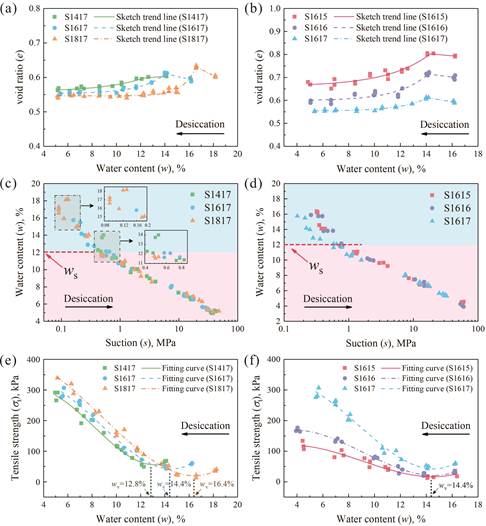
Fig. 2 Variations of void ratio, suction, and tensile strength with water content for compacted soils during freeze-thaw cycles.
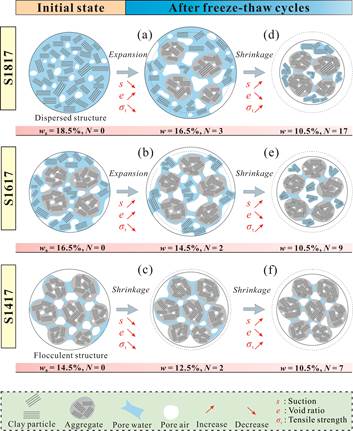
Fig. 3 Schematic diagrams illustrating the microstructure of compacted soils after several freeze-thaw cycles.