In cold regions, long-term freeze-thaw cycles can severely compromise soil structure and reduce its mechanical properties, raising the risk of various geological and geotechnical hazards, such as land subsidence, reservoir seepage, and infrastructure instability. To mitigate soil degradation and prevent potential hazards, traditional curing agents like cement and lime are commonly used to strengthen soil. However, the low-temperature conditions in cold regions significantly inhibit the chemical reactions of these agents, diminishing their reinforcement effectiveness and posing serious challenges to soil stabilization and engineering safety.
In response, Prof. Tang Chao-Sheng's team in our center innovatively proposed Bio-Carbonation of Reactive Magnesia (BCRM) based on urea pre-hydrolysis strategy, which is applied to soil improvement in low-temperature environments in cold regions. The research team conducted mechanical tests on bio-carbonized samples cured at various curing temperatures (Figure 1), confirming the feasibility of this technology to effectively enhance soil properties at low temperatures of 5°C to 15°C. Additionally, XRD and SEM microscopic analyses revealed the underlying mechanism by which BCRM technology achieves efficient soil stabilization in cold conditions (Figure 2). Comparative analyses with ordinary Portland cement highlighted the superior efficiency of BCRM technology in stabilizing soil in cold regions, showing higher ultimate strength and shorter curing age at low curing temperatures (Figure 3).
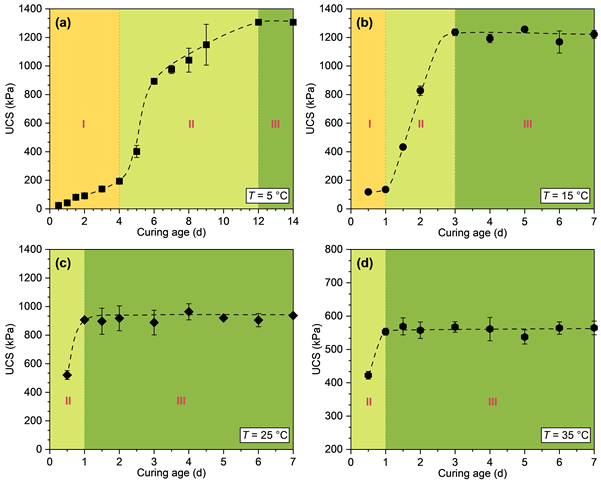
Figure 1. UCS development of bio-carbonized with curing age under different T.
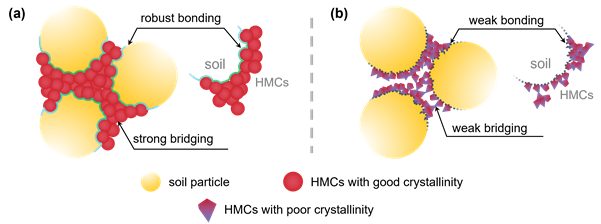
Figure 2. Cementation patterns of bio-carbonized samples cured at different T: (a) low T case, and (b) high T case.
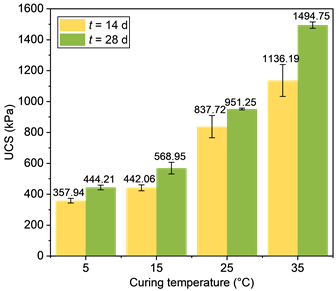
Figure 3. UCS results of OPC-reinforced samples after 14 d and 28 d curing at different T.
This research offers an efficient solution for soil improvement under low-temperature conditions in cold regions, which is of great significance in preventing and mitigating the risk of geological and geotechnical hazards caused by soil degradation. The relevant findings were recently published in the leading journal Engineering Geology, under the title “An efficient bio-stabilization technology with bio‑carbonation of reactive magnesia for soil improvement in cold regions”. Ph.D. candidate Wang Rui from our center is the paper's first author, with Professor Tang Chao-Sheng and Associate Professor Pan Xiao-Hua as co-corresponding authors. This work was supported by the National Natural Science Foundation of China, the National Key Research and Development Program of China, the Key Task Project for Joint Research and Development of the Yangtze River Delta Science and Technology Innovation Community, Natural Science Foundation of Jiangsu Province, and the Postgraduate Research & Practice Innovation Program of Jiangsu Province.
Paper information:Wang, R., Tang, C.S.*, Pan, X.H.*, Wang, D.L., Dong, Z.H., Lu, X.C., 2024. An efficient bio-stabilization technology with bio‑carbonation of reactive magnesia for soil improvement in cold regions. Eng. Geol. 343, 107779.
Web link:https://doi.org/10.1016/j.enggeo.2024.107779
